Mutya Publishing House, Inc.
  • Home
  • Our Product
    • Filipino 1
    • Filipino 2
    • Filipino 3
    • Other Filipino
    • English 1
    • English 2
    • English 3
    • English 4
    • English Major
    • PE
    • Ethics
    • History
    • Computer
    • Philosophy
    • Psychology
    • Rizal
    • Science
    • Sociology
    • HRM
    • Spanish
    • Math
    • Drawing
    • Business
    • Humanities
    • NSTP
    • Logic
    • Others
  • About Us
  • Contact Us
  • Self-learning Modules
Prev
  / 
Next

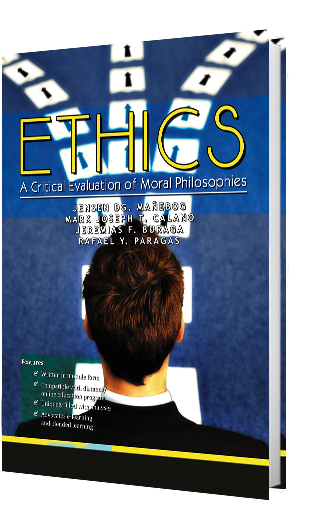
Ethics

Authors:  Jensen DG. Mañebog, Mark Joseph T. Calano, Jeremias F. Buraga, Rafael Y. Paragas

HAVING A SENSE of morality is one of the things that differentiates us from animals. By nature, we are sincerely concerned with what is right and what is wrong in human behavior. Unlike animals, we care about living out ethical principles.

Since we can elicit abstract concepts such as truth, righteousness, and goodness, reflection about morality has been an essential element of human civilizations. Around the world, people ask basic moral questions such as, “What is the good?” “What makes a life a good life?” “What are the virtues of a human being?” and “What duties do we have to each other?”

A course in Ethics is thus undoubtedly fundamental and necessary. The subject significantly helps in endorsing valuable moral and social values like cooperation, social responsibility, respect for human rights, compliance with the law, and peace preservation. As Ethics calls for rational and righteous living, it encourages making good choices and living a purposeful and meaningful life.

ETHICS: A Critical Evaluation of Moral Philosophies was written to serve as a comprehensive introduction to the study of morality and ethical evaluation. It humbly aims to help the readers develop a conscious ethical sense and become critical in choosing a moral philosophy to live by.

Some Features of this Book:

This book possesses various features that make it an effective tool for both instructor and students:

  1. Written in module form. Each lecture comes with other important elements like objectives, discussions, activities, self-tests, and others which make each module a holistic learning package.
  2. Compatible with distance/online education program. Having ample experience in teaching under distance learning program, the authors also designed this book for online students. Modular in form, the book is self-taught so students can also advance at their own pace. Online students' responses to activities, self-tests and discussions may be sent to their respective professors through e-mail.
  3. Uniquely filled with analyses. Unlike many Ethics books, its modules do not only present and explain the various moral philosophies but also critically evaluate them by deeply examining them in detail.
  4. Advocates e-learning and blended learning. When adopted by professors, many instructions under Activities will allow students to further learn from additional online lectures which were already screened and filtered by the authors. Some activities are even programmed to let the students experience engaging in intellectual discussions with other people anywhere in the world online.

To the Professors:

If used creatively, this book could also integrate the development of thinking abilities with the four language skills so crucial to success in college and careers: reading, writing, speaking, and listening. Through thought-provoking readings, writing assignments (answering questions in the 'discussions,' reaction papers, and essays), and discussion exercises, students can improve their language skills.

Each module is purposely designed to comprise the following parts:

  1. A set of specific objectives which allows readers to anticipate the concepts, principles or skills they will learn in the module.
  2. The lecture proper which presents and discusses in details the topics.
  3. The analysis part where the critical evaluation and appraisal of the ethical theory could be read.
  4. Discussions which contain questions and guide topics professors can use during lectures, or for recitation and evaluation. These lead the students to further internalize the subject matter.
  5. Activities which provide students with means through which they can further internalize the topic or experience how the concepts can be applied. These can also serve as pre-lecture or post-lecture homework, or classroom task when the professor could not attend class.
  6. Self-tests which measure how well the students comprehend the lecture. Professors may use them for evaluation (quiz, pre-test, etc.).
  7. Professors under distance learning program may supplement this book, for instance, by providing a calendar of deadlines on which online students have to submit their responses (answers to self-test, reactions to discussions, products for activities, etc.).
  8. Ultimately, professors arc free to treat each module either as a self-contained unit or as a launch pad to other teaching-learning processes.
  9. To the Students:
  • This book is designed to help you become knowledgeable and critical about various moral theories. Hopefully, this could also help you become better in reasoning skill, a quality which you can subsequently apply to your other academic subjects and various facets of life. The lectures, moreover, call for you to provide context for the topics by eventually considering them in forming or modifying your personal beliefs and principles.
  • To online students, you should treat this book as your personal tutor. By dedicatedly reading the lectures and faithfully accomplishing all the things required by your assigned professor, you can teach yourself the necessary knowledge and skills related to Ethics. Remember that those competencies cannot be acquired by unintelligently subscribing to 'cut-and-paste' malpractice in accomplishing your tasks and assignments.
  • To all students, if you wish to benefit much from this Ethics book, you should be ready to dedicate as much time as necessary. Taking this book seriously will help you transform into an intellectually mature, creative, and responsible moral person.
Categories: Ethics, Our Product. Tags: College Books, Ethics, Jensen DG. Mañebog, Jeremias F. Buraga, Mark Joseph T. Calano, Rafael Y. Paragas.
share on
Facebook
pin this item
on Pinterest
share it on
Twitter
Send to a
friend

Related Products

  • Business and Finance

    Author: Rowena A. Cuevas-Cinco

    “The most important adage and the only adage is, the customer comes first, whatever the business, the customer comes first

    – Kerry Stokes

    This book started as a concept paper on business finance and gradually, the compilation of materials from various authors of other business books and newspaper articles on business and finance, as well as the gathering of comments/suggestions of friends and family, creating it into a study guide for the introduction for business and finance. Fin 21 is a 3 unit course in the College of Business Administration with a description of Introduction to Business and Finance. The syllabus of the course is included in the manuscript. This book serves as a guide for business students, and would be entrepreneurs.

    The first part of the book is about the external environment of the business in a Philippine setting. It includes the economic system and business environment of the country, legal forms of business and the social infrastructure of business. The second part of the book is about business operations which technically is the internal environment of the business. It includes the different perspective of management, marketing concepts, production, human resources and information systems or the technology business has to deal with presently. The third part of the book is about financing operations. It gives a background about finance particularly on the Philippine financial system and monetary system. It includes the credit management most.

  • Art Appreciation

    Authors: Wilson K. Panisan, Leslie B. Gazzingan, and Warto M. Torrevillas

    Because Art Appreciation is one of the required general education subjects in he revised General Education Curriculum (GEC) come 2016, we decided to come up with a textbook that would comply with the general education course, This subject would focus on art as art which is primarily aesthetics. Students in Art Appreciation vain be taught how to view a work of art, what to look for and how to tell if an art work is good or bad. While aesthetics is evidently important because art, after all, is primarily aesthetic, the new subject will focus on the reationship of art to the individual student and his/her surroundings_ The course then aims to provide students the opportunity to examine, experience, and even produce works of art in order to appreciate their role and purpose in life.

    Students will be exposed to various categories of art such as visual arts (from the classical art forms to the modern art installations), the performing arts (music and dance, particularly Modern and Contemporary Ballet), drama and film (from mainstream to indie films), enhanced e-books, and multi-media aesthetics. This subject will thus build upon and hone the skills of urderstanding, critical appreciations and expressions of one's views. At the end of the semester, students should be able to understand and approach a work of art from a perspective informed by history and tradition and the social environment in which the art work is created. Like the other General Education Subjects, this subject is multi-disciplinary wherein students must use tools from various disciplines other than aesthetics to come to terms with the way art influences their personal lives.

    At the end of each chapter, various creative exercises and activities wit be answered by students to measure their cognitive learning aside from the reaction and critique papers they will submit after watching a ballet presentation, a musical concert, an indie film, or an actual painting demonstration. Research and data collection skills will also be enhanced thru library work and Internet research. individual and group activities will be assigned in class in order to improve communication and teamwork skills thru sharing and group activities. We believe that in this age of information technology, students should be trained and tapped to integrate and utilize machinery and computer software ire creating beautiful artistic works of art.

    it is our hope that the textbook will guide the students to develop appreciation and appraisal of the various arts forms and he range of the works of art the students

    be taught and exposed to. We hope that at the end of each chapter in this textbook, the students would be able to employ the communicating nature of the various media of arts as a catalyst or tool in understanding themselves as individuals and the society in which they live.

  • PE 1 Introduction to Gymnastics – Domingo

    Authors: John Paul R. Domingo, Joanna B. Alonte, Paulina A. Co, Adeluisa B. Alonte, Jocelyn R. Patana, Danilo L. Cong-o, Flordeliza V. Garcia, Hernan A. Nazuel

    Since the issuance of Department Order No. 15, s. 1967, “Physical Education and Sports Development Program,” the emphases of the Physical Education program in our country have been on physical fitness, social training, and personal discipline for all pupils and students as well as on the development of potential athletes who are physically gifted and inclined to specialize in athletics. More explicitly stated, “The goal of physical education is to instill in young citizens a proper appreciation of the importance of physical development in individual and social activities (A. Rivera, 1991).

    This book will better aid the teachers in developing the capabilities among the students. The students are expected to visualize, conceptualize, verbalize, and actualize the field of gymnastics. It is also hoped that they will be able to apply the training principles and methods discussed here beyond their PE classes. After all, physical development is not only an obligation of the State or a concern of the schools and P.E. teachers, but most importantly, a duty of every individual, whether or not taking PE.

    This book consists of thirteen chapters starting from introduction to physical education with physical fitness and wellness. Emphases will be on the six phases of gymnastics. Moreover, cheer dance was included to provide ideas on basic movements, skills, and terminologies.

    Activity tests are provided at the end of each chapter to mitigate the workload of teachers handling P.E. 1 (Gymnastics). However, teachers are advised to conduct other activities that will address the varying needs of their students and to evaluate students' aptitude and performance using varied forms of instruments for reliability, accuracy, and validity.

    The authors of this book are indebted to the authors of the various sources cited in this book. They also wish to express their gratitude to Mr. Jerome M. Katipunan of the Mutya Publishing House, Inc. for his trust and confidence in them, and more specially, for the opportunity to contribute, in this humble way that they can, in the effort to better facilitate the teaching-learning process in the tertiary level.

    Likewise, gratitude is due to all teachers who will find this book useful in their classes, and all PE. 1 students who, hopefully, will appreciate the value of this book in their pursuit for knowledge and skills for a better life that they all deserve.

Copyright © Mutya Publishing House, Inc. All Rights Reserved, 2020