-
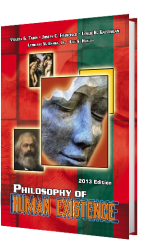
Philosophy of Human Existence 2013 (Tabin)
Authors: Violeta G. Tabin, Joseph C. Francisco, Leslie B. Gazzingan, Lamberto M. Bamba, Jr., Lou S. Hualda
Whenever one asks a student about his/her concept of the word philosophy, one would hear the answer that it is 'difficult,' that there is no relationship with one's course, or it is about pilosopong tasyo wherein one engages himself/herself in an argument that is unsubstantial. Hence, to change this concept in the mind of an individual, the authors have conic up with a textbook that is more student-friendly with the hope that it will help open the minds of an individual to become aware of, realize and appreciate, philosophy as part of one's existence.
The book, Philosophy of Human Existence, is a result of the collaborative effort of the authors to produce a more simplified college textbook on this subject. The book is divided into three parts: Part I — Philosophy of Man and Its Beginnings, which covers the Meaning of Philosophy and Its Branches and Purpose; Part II — Human Person in Relation to His World and His God, which covers Man as He Co-exists with Others and Moral Views on Human Person in the Context of Christian Philosophy; Part III — Issues Related to Human Equality and Relationship, which covers Domestic Violence, Violence Towards Self and Others, and National and International Violence.
The method in studying the nature of man shall be a presentation of the different and varied views or philosophies on the human person. From Western philosophies to Eastern philosophies, and with different ideologies, such as atheists' views, the student's own ideology or philosophy will be challenged using his/her own critical thinking. The Christian philosophy on the nature and condition of man shall be presented as well. Finally, issues and problems on human as he/she relates with his world .and others, both national and international shall also be presented for discussion,
-

Physics 1 Lab Manual
Authors: Irin M. Malajito, Mara Crisaliz B. Paras, Myra S. Ferrer
This laboratory manual has been created to substantiate the concepts being presented during the lecture in Physics 1. It would be most beneficial if a particular theory will be presented to the students before an experiment is performed. The procedures in this manual are detailed, constructed step.by-step in order for the students to be independent in their performance of the experiment. The application questions link the concepts of physics with everyday scenario for better retention, and with industry practices in order to create mindset among students of their future tasks. The exercises will enhance the skills of the students in problem solving.
OBJECTIVES OF PERFORMING THE ACTIVITY IN PHYSICS
Laboratory work is designed to:
familiarize students with the fundamental principle of the subject firsthand manipulation of apparatus and personal application of the principle studies.
train students with the methods and thoughtful experience in experimentation, careful observation and honest recording of data, critical analysis, correlation and interpretation of experimental data
familiarize students in the use of laboratory apparatus and techniques used in physical measurements
train students in making valid and worthwhile conclusion from observed data.
-

Practical Approach to Information Communication Technology (ICT)
Authors: Elika S. Farshid Mehr, Frederic D. Yulo
About Information Communication Technology (ICT)
Technology as we understand it today began its predominant presence in people’s daily life more than 20 years ago. But the need to know it more closely and utilize it out of necessity did not exist until the birth of the new millennia. Today’s success in education, business, administration, government, and military aspect is vitally dependent to technology. However, what makes technology so important is not technology itself or the common attributes that are given to it, such as convenience, reduced costs, ease of access and etc. but what gives notion and meaning to it—that is Information. Information since the dawn of history has been a vital source of man’s survival and success. Today’s success, however, does not only depend on much information one has but how fast he/ she can access, exploit, create and communicate it. This is where technology and information unit work to people’s advantage and make it so important to learn how they work and how they move each day’s activities to the next.
The Idea of Writing this book
The notion of creating this book developed about a year ago. The primary objective was to provide a simplified and inexpensive way of learning ICT for students and learners in the Philippines. As educators in higher education level we were able to observe students’ limitations and lack of eagerness in purchasing prescribed textbooks mainly due to lack of funds. Therefore we came up with the idea of creating a concise, practical, and inexpensive book which would contain essential knowledge that everyone has to know about technology. With our family, friends, and colleagues encouragements we were motivated to set the plans into motion and began drafting the very first chapters. And after a year of debating and adding and removing chapters and sections we have finally come to offer the compilation of all things we found, wrote and found useful to the reader. This book has been made for anyone specially those who have little means to purchase gadgets or computers or learn IT closely.
The readers are encouraged to send their valuable feedbacks to fredericyulo@ yahoo.com. Suggestions for the improvement of the text are also welcome.
-

Practicum Manual
Authors: Celia E. Cariño, Winifredo F. Garcia, Dominador D. De Asis, Jr, Stilo Floyd Schneider
This manual is intended to serve as practical guide to students who will take their practicum for hotel and restaurant. The manual serves the following purposes:
- To introduce students and practicum coordinator to the Hotel and Restaurant Practicum Program;
- To serve as a resource for students in planning the practicum experience in the Hospitality Industry;
- To articulate the policies and procedures of the Hotel and Restaurant Practicum Program for students and practicum coordinator; and
- To describe requirements of the Hotel and Restaurant Practicum Program.
Additionally, this manual is meant to be used in conjunction with the over-all policies and guidelines of different hotels and restaurants in regard to their Practicum Program including requirements, important student policies, and academic policies of the school. There are many procedures, sequences of courses, deadlines, and academic requirements that students need to know so they may proceed smoothly through their practicum. Each student has an assigned advisor with whom she/he is expected to keep on-going consultation. The student is the one primarily responsible for knowing the information in this manual and keeping apprised of deadlines and ongoing requirements and responsibilities.
The Hotel and Restaurant Practicum experience is a major testing ground for the student's knowledge, skills, and values. The student is supported in this experience by the leadership of her/his practicum coordinator. The goals and activities presented are intended to provide helpful guidance and structure to aid in a successful practicum experience for the student and to the participating hospitality industry partners.
Students' excellence in learning is improved through techniques, strategies, and innovation which are provided different types of practice of these skills in their course. Students also learn how technology has become part of the hospitality industry and the skills related to the use of technology in the different departments of the hotel and restaurant. The development of learning becomes a dynamic process based on theories, researches, best practices, and professional standards for HOSPITALITY INDUSTRY.
-
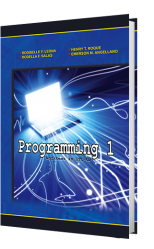
Programming 1 Worktext in ITC-02
Authors: Rodibelle F. Leona, Rodella F. Salas, Henry T. Roque, Emerson M. Angellano
Programming 1, WorkText in ITC-02 was created to enable Information Technology students understand the basics of programming using the C++ Language. It is designed in such a way that the context of the language can be easily comprehended by the students with less of the jargons of a computer language.
The authors discussed the programming concepts thatwill introduce the students to the world of programming. They tackled the components of the computer system, the steps used in programming, the elements and the programming paradigms. The second chapter deals mainly in the history of Programming Languages where the Control Structures and Flowcharts are also discussed. This WorkText also included the discussion about Code:Blocks, its parts and functions.
The WorkText also has a comprehensive discussion about the identifiers and data types, the operations that can be used in programming (mathematical, relational and logical) and assignment statements. The simple Input/Output commands are also given ample discussions.
The last part is consist of the decision making structure wherein data is subjected to comparison and the course of action of the program will be based on the value of the comparison.
Seatworks and Laboratory Exercises are also included in this WorkText so that students will be able to apply what they have learned through the discussions.
-
Quantitative Research
Authors: Amorado, Boholano, Talili
Newly Released
-
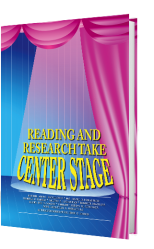
Reading and Research take Center Stage
Authors: Bethel Ann C. Batallones, Ma. Hazel B. Forastero, Nerissa C. Cabello, Arlene E. Lumantao, Rommel Maglaya, Glory Dee D. Magno, Emilou Lindsay M. Mendoza, Noel Christian A. Moratilla
Authors/Coordinator: Irish C. Sioson
As a sequel to “Spotlight: Study, Thinking and Writing Skills”, this book aims to further hone students' reading and writing skills situated in the research context. Reading and Research Take Center Stage is designed to reinforce and strengthen critical thinking and research skills of budding researchers as they face the various research-based tasks the academic and professional world demand. This book, which is a product of careful research, further aims to instil the values of scientific inquiry, sense of responsibility and discipline research entails. Emphasizing on the importance of research, the modules contained in this book guide the students to walk through the process of research and help them to recover, discover, rediscover, refine, define, or refine personal, social, economic, gender, environment and professional issues as reflected in the research articles coming from different disciplines.
This purposive part includes specific primary and secondary skills which are clearly and concisely articulated to help set goals for the readers.
This exciting starter warms up, encourages and stimulates readers' curiosity a varied and enjoyable activities are included to introduce the topics and prepare ther for the lesson.
This priceless part serves as a bridge to the Audition and the actual reading selection by linking the preparatory activities and the subject being investigated by the research article through previewing the text.
This extraordinary element prepares the reader for a closer reading of the text as students are engaged in a dialogue with the text/ author through annotation and effective note taking.
This special section provides explicit input for the focus reading skill, emphasizing specific strategies to demonstrate and develop the necessary skill for thinking, reading, and research.
Rehearsal
This practical part encourages collaboration between and among students as they are guided by their instructor in practicing or rehearsing the skills to prepare them for independent work eventually.
Performance
This super section provides challenging and engaging opportunities for individual and collaborative application of reading and research skills presented.
Encore
This section promotes careful and thoughtful reflection among readers to ponder on their strengths, progress and areas for improvement. This helps them become more self-directed and metacognitive learners.
Various performance-based rubrics are also provided to ensure effective assessment of students' processes and outputs to aid students monitor their own learning and guide educators supplement and design instruction.
-

Rizal
Authors: Jensen DG. Mañebog, Pedrito B. Placio, Rodrigo DP. Tomas, Rafael Y. Paragas, Nirvana SG. Bides
Editor: Jensen DG. Mañebog
HISTORY IS COMMONLY DEFINED as a story about the past that is significant and true. Admittedly Jose Rizal is an item of the 'past'. Arguably nonetheless, the known information about his life, works, and writings—which can be proved `true' based on preserved 'relics' and artifacts—are significant even to present generation.
History subjects like Rizal can be meaningful and practicable though it largely depends on the teacher presenting the subject and the instructional materials used. Pertinently one of the humble aims of this book is to introduce the course in such a way that the teacher and students alike would find it interesting and meaningful.
This book possesses the following distinctive features:
1. Includes new researches
In light of recent findings, this book, for instance, discusses what happened to Josephine Bracken, Paciano, Dona Teodora, Rizal's other siblings, and other relevant Filipino heroes after Rizal's martyrdom.
Clarifies some controversies and discrepancies
Many sections deal with historical controversies like whether or not Rizal indeed graduated as 'valedictorian' in Ateneo (as some references claim) and whether or not he did write the poem `Sa Aking Mga Kabata'.
Advocates c-learning and blended learning
It contains interesting 'interactive online activities' and suggests supplemental online readings. Connectedly, the hook is compatible with online education program.
With analyses, comments, and applications
Whenever appropriate and needed, significant remarks and relevant supplemental information are embedded in the lectures. Some lectures also state the relevance, value, and applicability of the topics to our lives.
Uses blog and feature-article format
To be appealing to young generations, some lectures somewhat deviate from the traditional too formal (like straight news) style. Instead, they are written the way blogs and online articles are.
Features other Filipino heroes
As many schools are now including other Filipino heroes in the syllabus for the Rizal subject, this book pertinently features many of them (e.g. Del Pilar, Bonifacio, and Aguinaldo as it identifies Rizal's relations and collaborations with them.
-
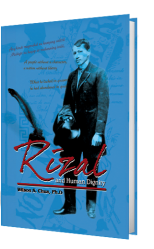
Rizal and Human Dignity
Authors: Wilson S. Chua, Ph.D
Our country had been set apart to have a hero in the person of Dr. Jose Rizal, At the tender age of eight, he was already aware of the importance of nationalism and began honing his artistic talents for the country, as can be seen in his first poem “Sa Aking mga Kabata”. Although extraordinarily gifted, Rizal chose not to enrich himself with his God-given talents but instead try to uplift our country by reaching out to Filipinos through his writings. Each one of Rizal's work of art is a masterpiece, filled with human values, ideas, lessons, and principles that were deeply embedded within him. His works are timeless, the messages they convey still touch the lives of modern Filipinos just as they have touched the Filipinos during the Spanish era, filling their hearts with love for the country.
Included within these pages are some of Rizal's best poems and essays, every one of them filled with meaningful messages with which will enlighten and encourage the Filipinos who will read them to love and serve the country. With this purpose in mind, each literary piece featured here is accompanied by information as to when, where, and why it was written by Dr. Jose Rizal. Written commentaries by distinguished personalities are also presented for each literary piece. Furthermore, much effort had been exerted and diligence in presenting the various ideas and values that Rizal had been implanted within his poems and essays.
Let this short journey into the mind of Rizal through his poems and essays bear fruit in the lives of the readers, enriching them not only with fortitude but excellence and uprightness as a person. With every glimpse of Rizal's person mirrored in his words, let us not forget that there was once a man whose dreams were dedicated to the Philippines. His every labor was for the betterment of the Filipinos; his death was for the glory of the country. Let us stand witness to the greatness of the man called Dr. Jose P. Rizal.
-
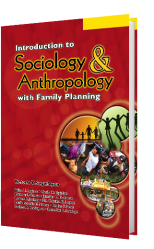
Sociology and Anthropology with Family Planning 2011 (Saquilayan)
Authors: Felisa U. Aguirre, Cecile D. Espiritu, Miramar I. Garcia, Jennifer M. Hobrero, Romeo R. Javines, Ma, Cristina D. Lopez, Maria Rosario E. Monce, Berlyn F. Pa-at, Evalyne A. Rodriquez, Benedict B. Santiago
Sociology and Anthropology are exciting as well as challenging fields of scientific study. It is exciting because it is dynamic and challenging because it opens up a lot of avenues for a continuing knowledge and understanding about the world, people and events. It is about people who are engaged in daily and non-stop activity.
As part of this life activity, this compendium is designed to sere as an introductory material on Sociology and Anthropology. Both scientific fields. although comparatively young in the academic world have been regarded not only as beneficial but moreso, very essential in the preparatory stage of one's understanding about life and the surrounding environment.
The immensity of the subject on both fields of study is given. May this compendium aid the students through their teachers as they engage themselves in this study.
-
Statistics and Probability
Authors: Roland s. Zorilla, Beda H. Esller, Violeta C. Mendoza, Lori Marseli L. De Castro, Gerry Go. Abenilla
Newly Released
-
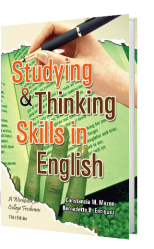
Studying and Thinking Skills in English
Authors: Constacia M. Mazon, Bernadette B. Enriquez
YOUR STUDYING AND THINKING task here is meant to enhance your communication skills in English for you to cope effectively with your academic requirements. The lessons and activities are designed to make you achieve the desired enhancement These are composed and developed into nine chapters.
The first chapter is about paving the way to an enhanced studying and thinking skills in English — focusing on getting an overview of the course through the syllabus, using the library, taking down notes, and honing critical and creative thinking.
The second chapter is about enhancing studying and thinking skills to cope with the demands of an examination before, during, and after taking it. ft focuses specifically or coping with the given instructions and on answering the questions asked in A.
The third chapter is about identifying and stating a fact and an opinion and on identifying and drawing out an inference.
The fourth chapter is all about enhancing studying and thinking skills towards effective reading in English.
The fifth chapter i ail about enhancing studying and thinking skills in English towards reading with comprehension essays, short stories, drama, and poems.
The sixth chapter is about enhancing studying and thinking skills towards effective writing and speaking in English.
The seventh chapter is about enhancing studying and thinking skills towards unity, coherence, and emphasis in developing and organizing ideas.
The eighth chapter is ail about enhancing studying and thinking skills in English towards effective development and organization of ideas in speaking and writing.
And the ninth chapter is about enhancing studying and thinking skills in English towards writing a good paragraph, essay, summary, and paraphrase.
Each lesson gives the nature of the studying and thinking work to be done and some techniques that can be used for the task to be done more efficiently.
Overall, this program of lessons is your writer's well-meant response to the syllabus suggested for use in tertiary English One by the Commission on Higher Education (CHED).

-
Philosophy of Human Existence 2013 (Tabin)
-
Physics 1 Lab Manual
-
Practical Approach to Information Communication Technology (ICT)
-
Practicum Manual
-
Programming 1 Worktext in ITC-02
-
Quantitative Research
-
Reading and Research take Center Stage
-
Rizal
-
Rizal and Human Dignity
-
Sociology and Anthropology with Family Planning 2011 (Saquilayan)
-
Statistics and Probability
-
Studying and Thinking Skills in English
Copyright © Mutya Publishing House, Inc. All Rights Reserved, 2020