Mutya Publishing House, Inc.
  • Home
  • Our Product
    • Filipino 1
    • Filipino 2
    • Filipino 3
    • Other Filipino
    • English 1
    • English 2
    • English 3
    • English 4
    • English Major
    • PE
    • Ethics
    • History
    • Computer
    • Philosophy
    • Psychology
    • Rizal
    • Science
    • Sociology
    • HRM
    • Spanish
    • Math
    • Drawing
    • Business
    • Humanities
    • NSTP
    • Logic
    • Others
  • About Us
  • Contact Us
  • Self-learning Modules
Prev
  / 
Next

Rizal

Authors: Jensen DG. Mañebog, Pedrito B. Placio, Rodrigo DP. Tomas, Rafael Y. Paragas, Nirvana SG. Bides

Editor: Jensen DG. Mañebog

HISTORY IS COMMONLY DEFINED as a story about the past that is significant and true. Admittedly Jose Rizal is an item of the 'past'. Arguably nonetheless, the known information about his life, works, and writings—which can be proved `true' based on preserved 'relics' and artifacts—are significant even to present generation.

History subjects like Rizal can be meaningful and practicable though it largely depends on the teacher presenting the subject and the instructional materials used. Pertinently one of the humble aims of this book is to introduce the course in such a way that the teacher and students alike would find it interesting and meaningful.

This book possesses the following distinctive features:

1. Includes new researches

In light of recent findings, this book, for instance, discusses what happened to Josephine Bracken, Paciano, Dona Teodora, Rizal's other siblings, and other relevant Filipino heroes after Rizal's martyrdom.

Clarifies some controversies and discrepancies

Many sections deal with historical controversies like whether or not Rizal indeed graduated as 'valedictorian' in Ateneo (as some references claim) and whether or not he did write the poem `Sa Aking Mga Kabata'.

Advocates c-learning and blended learning

It contains interesting 'interactive online activities' and suggests supplemental online readings. Connectedly, the hook is compatible with online education program.

With analyses, comments, and applications

Whenever appropriate and needed, significant remarks and relevant supplemental information are embedded in the lectures. Some lectures also state the relevance, value, and applicability of the topics to our lives.

Uses blog and feature-article format

To be appealing to young generations, some lectures somewhat deviate from the traditional too formal (like straight news) style. Instead, they are written the way blogs and online articles are.

Features other Filipino heroes

As many schools are now including other Filipino heroes in the syllabus for the Rizal subject, this book pertinently features many of them (e.g. Del Pilar, Bonifacio, and Aguinaldo as it identifies Rizal's relations and collaborations with them.

Categories: Our Product, Rizal. Tags: College Books, Jensen DG. Mañebog, Jose Rizal, Nirvana SG. Bides, Pedrito B. Placio, Rafael Y. Paragas, Rizal, Rodrigo DP. Tomas.
share on
Facebook
pin this item
on Pinterest
share it on
Twitter
Send to a
friend

Related Products

  • Art Appreciation: Looking Beyond

    Authors: Ronnie Espergal Pasigui, Fabian T. Avila, Jr., Araceli C. Suyat, Warto M. Torrevillas, and Allan V. Pura

    “Come to the edge,” he said.
    They said, “we are afraid.”
    Come to the edge,” he said.
    They came. He pushed them, and they flew.
    (Apollinaire)

    As we stand at the edge of these challenging years, gazing out into its uncharted expanse, some of us feel as if we are stepping out onto a launching pad; others feel at the brink of an abyss. Some see the challenges and the marvels to come and are exhilarated; some see only the certainty of change and its uncertain outcomes and are apprehensive. How amazing it is to note that many instructional materials, textbooks, in particular remained as they were.

    This book is a response to the challenge of writing a newer book in the humanities course. It includes features to aid the students in the understanding of the subject.

    A. Each chapter has the following features to help both the instructor and the student.1

    1. An overview of the chapter
    2. Learning objectives
    3. Key words for understanding
    4. Aids for study
    5. Exercises

    B. Chapters on the different art forms include the following features:

    1. Historical development of the art form
    2. Emphasis on Philippine art
    3. Discussion of Art and Society
    4. Inclusion of websites

    C. Optional chapters for alternative approach in teaching humanities are included:

    1. Functions Of Art (Chapter 3)
    2. Art Theories (Chapter4)
    3. Photography (Chapter 16)
    4. Discipline-based Art Education (Chapter 17)

    D. Instead of including an introductory discussion on literature as an Art, the authors focused on specific literary form— Drama. This is not to underestimate the other literary forms suck as poetry, novels, short stories, etc. Drama 15 a literary form almost within man's existence.

    E. Powerpoint Presentation of selected topics are available for teachers as supplementary materials upon request.

    These features, hopefully give this book an edge!

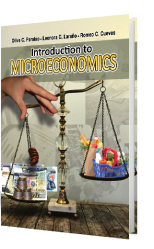
  • Intorduction to Microeconomics

    Authors: Olive C. Paraiso, Leonora C. Laraño, and Romeo C. Cuevas

    The purpose of this student learning material is to present an understanding of economics as an easy and enjoyable subject This learning material can be an aid to instructors and students because it presents the subject in a manner in which it can be easily understood. It could also prove useful, especially to students as a ready-made lecture notes that could save time spent in note-taking.

    Each chapter is discussed and is followed by exercises to check the students' understanding. The series of check-up questions provide students to actively participate in classroom discussions and analyses.

    Let this learning material be a guide in learning economics the easier way. This learning material be useful to all those performing in the important task of improving economic understanding and in the appreciation of subject.

    Grateful recognition is afforded to our supportive colleague for the untiring motivation with regard to the pursuit of ideals and excellence in extracting ideas and thoughts from both the teaching force and the students.

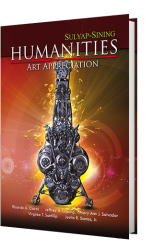
  • Humanities Art Appreciation

    Authors: Ricardo A. Clores, Jeffrey A. Lubang, Mary Ann J. Salvador, Virginia T. Sanfilip, and Jovito R. Santos Jr.

    Where do we put the humanities and the arts in a nation that budges and prods its students, like a mantra recited on a daily basis, to take skilled works? Today, the demands of the First World markets are nurses, caregivers and call center agents. Tomorrow, First World needs might shift to hotel and restaurant management practitioners, plumbers, electricians, automechanics and the like. As the country sinks deeper in its economic woes, at the same time tightens its grip even more to First World needs, students are left with no other choice but to submit. Not that there is anything wrong with being a caregiver or a call center agent, if this is what a student truly wants, but the condition paints even more of the pathetic and dwindling opportunities and possibilities for Filipino students.

Copyright © Mutya Publishing House, Inc. All Rights Reserved, 2020