Mutya Publishing House, Inc.
  • Home
  • Our Product
    • Filipino 1
    • Filipino 2
    • Filipino 3
    • Other Filipino
    • English 1
    • English 2
    • English 3
    • English 4
    • English Major
    • PE
    • Ethics
    • History
    • Computer
    • Philosophy
    • Psychology
    • Rizal
    • Science
    • Sociology
    • HRM
    • Spanish
    • Math
    • Drawing
    • Business
    • Humanities
    • NSTP
    • Logic
    • Others
  • About Us
  • Contact Us
  • Self-learning Modules
Prev
  / 
Next

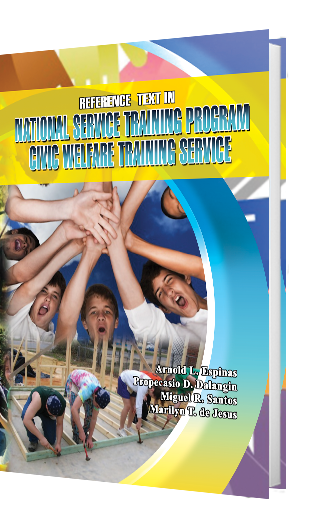
National Service Training Program Civic Welfare Training Service

Authors: Arnold L. Espinas,  Propecasio D. Dalangin,  Miguel R. Santos,  Marilyn T. de Jesus

This reference text is a result of a long search for the appropriate materials for the Civic Welfare Training Service (CWTS). One of the principal aims of the NSTP is to instill in the minds of the young Filipinos the culture of volunteerism. But developing a high sense of volunteerism is not enough to make the young citizens become effective agents of development. In order to become an effective community worker, each student of CWTS must possess not only the ability to identify the problems of a community. He must also exhibit the ability to understand causes and effects of those problems which will provide great help in formulating the kind of intervention needed to confront them.

The task of student community workers is not easy, especially on the part of those still in the process of gaining accurate perspective of the dynamics of the community. Each community is characterized by various complexities of sociocultural realities. That is indeed the reason why the authors believe that there can never be one written material capable of providing complete answers to the issues of even one community. But even so, this reference text hopes to share relevant information that will encourage young individuals to become empowered members of the society to which they belong. Empowerment would mean being always ready to initiate actions instead of just being plain participants in any community building efforts.

Categories: NSTP, Our Product. Tags: Arnold L. Espinas, College Books, Marilyn T. de Jesus, Miguel R. Santos, NSTP, Propecasio D. Dalangin.
share on
Facebook
pin this item
on Pinterest
share it on
Twitter
Send to a
friend

Related Products

  • Introduction to Sociology (UM)

    Authors: Saidamin P. Bagolong, Maribeth Q. Galindo, Jackson A. Sison, Deanna Febra C. Rodinas

    The purpose of this textbook is to serve as reference for an introductory course in Sociology. The inclusion of family planning and other social issues provides background knowledge for an understanding of these, and other contemporary conditions.

    The book is likewise designed to facilitate the integral development of students for them to effect changes in the self as well as the environment thereby realizing the fullness of human life.

    Even though this is an introductory textbook, we have deliberately retained many of the salient features of sociology as a young discipline. This is the reason why we incorporated many social issues to stimulate students’ curiosity about learning society, culture, family planning, gender, environment and eve indigenous people.

    This textbook could not have been written without help from many people whose ideas we have borrowed, modified and incorporated. To them we are deeply indebted.

  • Flat Socio-Cultural

    Authors: Saidamin P. Bagolong, Allan Hil B. Pajimola, Bryan Lee D. Celeste

    The purpose of this textbook is to serve as a reference for an introductory course in Anthropology. This war, focus on concepts and theories of anthropology combined with both social and cultural understanding of humankind. Moreover; this will define basic terms of the course and how it can change your view of the world around you.

    The textbook is likewise designed to facilitate the integral development of students for them to effect changes in the self as well as in the environment, thereby realizing the fullness of human life.

    Even though this is an introductory textbook, we deliberately retain most of the salient features of anthropology as fairly new academic discipline.

    This textbook could not have been written without help from many people whose ideas we have borrowed, modified and incorporated. We owe these people a special debt.

  • Physics 1 Lab Manual

    Authors: Irin M. Malajito, Mara Crisaliz B. Paras, Myra S. Ferrer

    This laboratory manual has been created to substantiate the concepts being presented during the lecture in Physics 1. It would be most beneficial if a particular theory will be presented to the students before an experiment is performed. The procedures in this manual are detailed, constructed step.by-step in order for the students to be independent in their performance of the experiment. The application questions link the concepts of physics with everyday scenario for better retention, and with industry practices in order to create mindset among students of their future tasks. The exercises will enhance the skills of the students in problem solving.

    OBJECTIVES OF PERFORMING THE ACTIVITY IN PHYSICS

    Laboratory work is designed to:

    familiarize students with the fundamental principle of the subject firsthand manipulation of apparatus and personal application of the principle studies.

    train students with the methods and thoughtful experience in experimentation, careful observation and honest recording of data, critical analysis, correlation and interpretation of experimental data

    familiarize students in the use of laboratory apparatus and techniques used in physical measurements

    train students in making valid and worthwhile conclusion from observed data.

Copyright © Mutya Publishing House, Inc. All Rights Reserved, 2020