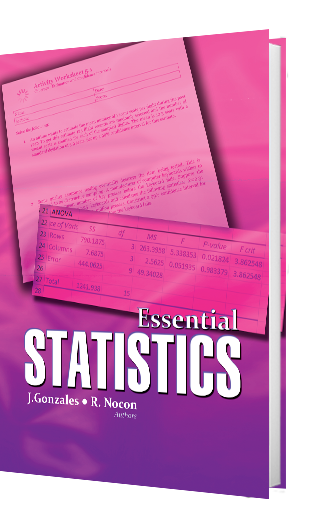
Essential Statistics
Authors: J. Gonzales, R. Nocon
There are so many books about statistics out there written both by local and foreign authors. So why come up with yet another one? This book makes use of the same format adopted for an earlier, similar book in Algebra found useful by many students and teachers. It utilizes step-by-step procedures, includes lots of exercises, and worksheets, offers opportunities for student reflection and real-world connections, highlights the use of technology-based tools, requires student projects, presents chapter highlights, and provides students preparatory materials for major examinations.. It also has materials on integrating student portfolios and learning papers into the course.
These features emphasize the authors’ belief and conviction that mathematics should be relevant meaningful, and interesting for today’s generation of students. In particular, it is hoped that this book will assist students become wise consumer of and more adopt writers of research.
Related Products
-
Studying and Thinking Skills in English
Authors: Constacia M. Mazon, Bernadette B. Enriquez
YOUR STUDYING AND THINKING task here is meant to enhance your communication skills in English for you to cope effectively with your academic requirements. The lessons and activities are designed to make you achieve the desired enhancement These are composed and developed into nine chapters.
The first chapter is about paving the way to an enhanced studying and thinking skills in English — focusing on getting an overview of the course through the syllabus, using the library, taking down notes, and honing critical and creative thinking.
The second chapter is about enhancing studying and thinking skills to cope with the demands of an examination before, during, and after taking it. ft focuses specifically or coping with the given instructions and on answering the questions asked in A.
The third chapter is about identifying and stating a fact and an opinion and on identifying and drawing out an inference.
The fourth chapter is all about enhancing studying and thinking skills towards effective reading in English.
The fifth chapter i ail about enhancing studying and thinking skills in English towards reading with comprehension essays, short stories, drama, and poems.
The sixth chapter is about enhancing studying and thinking skills towards effective writing and speaking in English.
The seventh chapter is about enhancing studying and thinking skills towards unity, coherence, and emphasis in developing and organizing ideas.
The eighth chapter is ail about enhancing studying and thinking skills in English towards effective development and organization of ideas in speaking and writing.
And the ninth chapter is about enhancing studying and thinking skills in English towards writing a good paragraph, essay, summary, and paraphrase.
Each lesson gives the nature of the studying and thinking work to be done and some techniques that can be used for the task to be done more efficiently.
Overall, this program of lessons is your writer's well-meant response to the syllabus suggested for use in tertiary English One by the Commission on Higher Education (CHED).
-
Pathways to Effective Communication in English
Authors: Theresa Y. Pesayco, Cherry Ann J. Gulay, Marianne P. Afrondoza, Dinah C. Hernandez, Mary Cris L. Ipan, Ediwn L. Nebria, Honorio P. Jumilla
Author/Coordinator: Nerissa C. Gabelo
“(Books are the plane, and the train, and the road: 'They are the destination and the journey. They are home.”
– How Reading Changed My Life, Anna Quindlen
The goal of every student in the tertiary level education is a career path that eventually improves the quality of life. The tool to achieve this goal is a challenge that all academic institutions recognize and competitively try to offer. Academic excellence becomes a drum-beater for all schools that boast of quality education.
Learning is a dynamic process that entails holistic development of a human being. Anchored on this vision, this book sets the benchmark for the comprehensive, practical and communicative learning of the English language. This book aims to set the students to achieve mastery of the English language through a ladderized approach–interrelated lessons that are arranged from the simplest to the most complex—keeping in mind how the human brain functions best when ideas are placed in good order.
This book is divided into two major parts—Structure of the English Grammar and Paragraph Development. Each part of the book is designed with learning elements that are distinctly adaptive to the lessons' content.
Part 1 – Structure of the English Grammar focuses on the comprehensive discussion of the eight parts of speech and introductory lessons on writing elements and writing mechanics. Each lesson contains Stumbling Blocks that serves as both diagnostic testing and lesson springboard for the students. The Path Finders is a comprehensive discussion of the lesson with numerous examples to ensure complete understanding of the lesson. The Learning Alley is the part where the students get to evaluate their understanding of the lesson through two sets of exercises that provide a variety of assessment.
Part 2 – Paragraph Development consists of lessons on methods of exposition through different patterns of paragraph development. Each lesson consists of Path Finders that discusses Do's and Don't's and How's of the writing process. The Writing Pointers presents sample paragraphs with sub-elements that guide the reading and writing of the method. The Pen's Tip includes pointers that guide students in understanding the mechanics of writing. Word Factory contains difficult words that are unlocked for better understanding of the sample paragraph. In The Note presents practical guidelines on the process of paragraph development. Comprehension Questions are provided to ensure that the paragraph's content is fully understood. The Writing Tips lists handy and practical pieces of advice on how to further improve
-
Programming 1 Worktext in ITC-02
Authors: Rodibelle F. Leona, Rodella F. Salas, Henry T. Roque, Emerson M. Angellano
Programming 1, WorkText in ITC-02 was created to enable Information Technology students understand the basics of programming using the C++ Language. It is designed in such a way that the context of the language can be easily comprehended by the students with less of the jargons of a computer language.
The authors discussed the programming concepts thatwill introduce the students to the world of programming. They tackled the components of the computer system, the steps used in programming, the elements and the programming paradigms. The second chapter deals mainly in the history of Programming Languages where the Control Structures and Flowcharts are also discussed. This WorkText also included the discussion about Code:Blocks, its parts and functions.
The WorkText also has a comprehensive discussion about the identifiers and data types, the operations that can be used in programming (mathematical, relational and logical) and assignment statements. The simple Input/Output commands are also given ample discussions.
The last part is consist of the decision making structure wherein data is subjected to comparison and the course of action of the program will be based on the value of the comparison.
Seatworks and Laboratory Exercises are also included in this WorkText so that students will be able to apply what they have learned through the discussions.