Mutya Publishing House, Inc.
  • Home
  • Our Product
    • Filipino 1
    • Filipino 2
    • Filipino 3
    • Other Filipino
    • English 1
    • English 2
    • English 3
    • English 4
    • English Major
    • PE
    • Ethics
    • History
    • Computer
    • Philosophy
    • Psychology
    • Rizal
    • Science
    • Sociology
    • HRM
    • Spanish
    • Math
    • Drawing
    • Business
    • Humanities
    • NSTP
    • Logic
    • Others
  • About Us
  • Contact Us
  • Self-learning Modules
Prev
  / 
Next

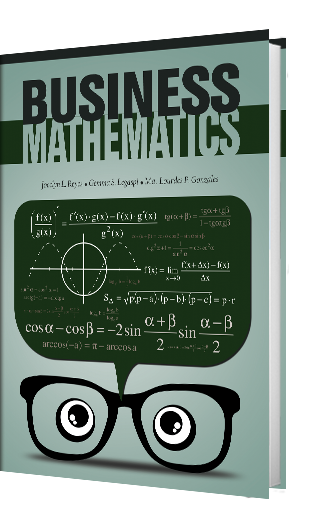
Bussiness Mathematics

Authors: Jocelyn L. Reyes,  Gemma S. Legaspi,  Lourdes P. Gonzales

Business Mathematics, sometimes called consumer math or commercial math, is mathematics used by commercial enterprises to record and manage business operations. Business mathematics is an important tool in accounting, inventory management, marketing: sales forecasting and financial analysis.

The emphasis of Business Mathematics in the tertiary curriculum is on computational skills and practical application. It also includes a review of elementary arithmetic including fraction, decimals and percentages. The practical applications typically include checking accounts, price discounts, markups and markdowns, payroll calculations, and simple and compound interest Luckily, even if mathematics is not one of the student's strengths, there are several avenues available for learning business math. The syllabus-based work text in Business Mathematics is one of them.

Although many of the skills necessary for business success are related to interpersonal savvy and marketplace knowledge, most well-rounded business people need to know basic math skills, ideal for financial reports and other vital business documentation.

Business mathematics prepares the students in making general business decisions, like whether to expand into a new branch, whether to hire another employee, or if a commodity is marketable. Knowledge of business mathematics makes calculations less tedious and time-consuming, saving the business and its customers time and money.

Categories: Math, Our Product. Tags: Bussiness, Bussiness Mathematics, College Books, Gemma S. Legaspi, Jocelyn L. Reyes, Lourdes P. Gonzales, Math.
share on
Facebook
pin this item
on Pinterest
share it on
Twitter
Send to a
friend

Related Products

  • Food Safety and Sanitation

    Authors: Mary Jean C. Ang,  Hannah A. Balanon,  Celia E. Cariño,  Eunice D. Guerero,  Marilou P. Pascual,  Ma. Cecilia P. Pradez

    Laboratory Manual for Principles of Food Safety and Sanitation with HACCP is a set of exercises to facilitate and enhance learning of the fundamental concepts of food safety, sanitation and hygiene and HACCP standards.

    This laboratory manual is specifically designed for students in the food service and hospitality management courses, allowing them to apply and correlate many of the food safety concepts with various activities.

    Organization of this manual is of two parts: Part I contains exercises for food safety and sanitation such as procedures for the identification of biological, chemical and physical hazards of food and Part II contains exercises applying the principles of Hazard Analysis and Critical Control Points (HACCP).

    Each exercise comes with a Title – an overview of the content; Principles – bases of the underlying concepts and procedures; Objectives — competencies that every student should gain after each exercise; Materials — list of instruments, equipment supplies and reagents that will be used for each exercise; and Assessment — questions to evaluate learning.

    The sequence of exercises is arranged in a way that will demonstrate the progression of the student from learning and mastering simple to complex procedures of food safety and sanitation with HACCP.

    Considering these parameters, the purpose of this laboratory manual is to guide students through a process of development of experimentation, interpretation of data, and discovery in a manner that will complement the lecture and make the study of food safety and sanitation with HACCP both exciting and challenging.

  • Appied Culinary Arts

    Authors: Nilo A. Alterado,  Edilberto M. Tawagon,  Loida R. Banzuelo

    Reviewer: Celia E. Cariño

    There is a little chef in every person. People love to eat. And eat sumptuous dishes at that. Needless to say, it is inherent in everyone to satisfy the craving of taste buds.

    This book is designed for students who want to learn more about cooking. It covers the basics of culinary arts and the preparation of complex but sumptuous dishes that are a treat in every table. Learning more about culinary arts will also prepare students for a more challenging, demanding yet rewarding career in the food service industry.

    This book follows a format that addresses specific and actual needs of students in the culinary discipline.

    Each chapter begins with a list of objectives that gives the students a bird's eye view of what to expect from each chapter.

    The lessons then go on with a brief background of each chapter followed by a comprehensive discussion of lessons that are arranged from the most fundamental to the most challenging tasks like execution, preparation of dishes, cooking and even table-setting.

    The lessons are graphically designed through the inclusion of pictures that are personally photographed by the authors to ensure better understanding among learners.

    Each chapter contains exercises that intend to measure students' understanding of the lessons. There are also exercises that evaluate the practical skills of the students. A specific rubric system is provided for better organization and measurement of the intended skills.

    To ease comprehension of the recipes included in the book, a glossary of terms is provided with phonetic translations as well.

    The recipes that are included in the book have been tested and specially designed for TESDA courses on BSHRM and HRS culinary arts subjects. Each recipe indexed at the end of the book to give easy access to those who would like to try it.

    Everybody loves to eat. Appetite is a special gift that must be freely enjoyed. But it takes more than appetite and cooking ability to be a good chef It takes discipline, passion and art.

    If you want to land a good career in the food industry, this book is a must for you.

  • Philippine History (UM)

    Authors: Deanna Febra Gillera Cantal,  Roen Caesar S. Cardinal,  Lindsey C. Espino,  Maribeth Quezon Galindo

    Many students may think that its irrelevant to study Philippine history subject since they could not change the past nor they have not seen the relevance

    subject itself and its relation to the course that they take up. Others may think that a boring subject full of memorization with dates, places, persons, events and others. Thus, this kind of perception may be placed in the context of students experiences on how they think, they look and they feel about the subject.

    A glimpse that Philippines was controlled by foreign colonizers for almost 400 years that during colonization period Filipinos were not taught their own history but rather they were taught the history of colonizers WHILE they were in our country and seemingly, Filipinos were trained like a parrot which resulted students less understanding and less appreciation of our own history.

    Hopefully, as students explore the history of the Philippines, they may see the fact that as a true blooded Filipinos, the fact that every generation was and will always be a product of History, Philippine history is still and will always be a relevant subject :1 regardless of what course a student takes up. Students may realize whatever mistakes 1 in the past are, the present generation may not repeat it and the future generation will be freed from the bondage of ignorance, tyranny and slavery. Students may develop a deep sense of commitment to serve God and love our country.

    Likewise, this textbook, may challenge new breed of historians and history teachers to go beyond dates, places, persons, events etc. Teaching the how's and why's of historical events will train students to be analytical and critical minded individual. Further, teachers may have seen the importance of contextualization so that students may have developed a deeper understanding of their origins, interpret historical events in a broader perspective and develop in them to be actively involved in non-violent; manner to any issues which have affected Filipino lives.


Copyright © Mutya Publishing House, Inc. All Rights Reserved, 2020