Mutya Publishing House, Inc.
  • Home
  • Our Product
    • Filipino 1
    • Filipino 2
    • Filipino 3
    • Other Filipino
    • English 1
    • English 2
    • English 3
    • English 4
    • English Major
    • PE
    • Ethics
    • History
    • Computer
    • Philosophy
    • Psychology
    • Rizal
    • Science
    • Sociology
    • HRM
    • Spanish
    • Math
    • Drawing
    • Business
    • Humanities
    • NSTP
    • Logic
    • Others
  • About Us
  • Contact Us
  • Self-learning Modules
Prev
  / 
Next

Basic Drawing 2

Author: Erich D. Cruz

This workbook is an edition specially prepared to completely encompass the syllabus in Drawing 2 of the First Year – Bachelor of Technology, Engineering and other related courses with various specializations.

This course provides the students with rudiments of working drawing. This enables the students to apply fundamental principles learned in introductory drawing.

The subject covered two parts: 1) First, it deals with the review of Orthographic and Pictorial Drawings. At this stage, while grasping the fundamentals of multi-view projections and pictorial drawings, more stress should be laid on accuracy, precision and neatness. Speed, which is also an essential requirement, can be achieved with constant practice. 2) Second, it deals mainly with the principles of dimensioning, scaling, sectioning, auxiliary views and pattern & surface development and their applications to simple machine parts for the purpose of their vivid description.

This is completely prepared so as to conform to the current practices of length measurement and projection system.

Practice exercises have been added purposely for drawing interpretations.

The author strongly believed the students will benefit immensely with the proper use of this workbook.

Categories: Drawing, Our Product. Tags: Basic Drawing 2, College Books, Drawing, Erich D. Cruz.
share on
Facebook
pin this item
on Pinterest
share it on
Twitter
Send to a
friend

Related Products

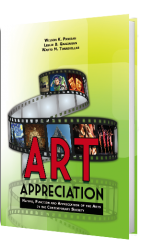
  • Art Appreciation

    Authors: Wilson K. Panisan, Leslie B. Gazzingan, and Warto M. Torrevillas

    Because Art Appreciation is one of the required general education subjects in he revised General Education Curriculum (GEC) come 2016, we decided to come up with a textbook that would comply with the general education course, This subject would focus on art as art which is primarily aesthetics. Students in Art Appreciation vain be taught how to view a work of art, what to look for and how to tell if an art work is good or bad. While aesthetics is evidently important because art, after all, is primarily aesthetic, the new subject will focus on the reationship of art to the individual student and his/her surroundings_ The course then aims to provide students the opportunity to examine, experience, and even produce works of art in order to appreciate their role and purpose in life.

    Students will be exposed to various categories of art such as visual arts (from the classical art forms to the modern art installations), the performing arts (music and dance, particularly Modern and Contemporary Ballet), drama and film (from mainstream to indie films), enhanced e-books, and multi-media aesthetics. This subject will thus build upon and hone the skills of urderstanding, critical appreciations and expressions of one's views. At the end of the semester, students should be able to understand and approach a work of art from a perspective informed by history and tradition and the social environment in which the art work is created. Like the other General Education Subjects, this subject is multi-disciplinary wherein students must use tools from various disciplines other than aesthetics to come to terms with the way art influences their personal lives.

    At the end of each chapter, various creative exercises and activities wit be answered by students to measure their cognitive learning aside from the reaction and critique papers they will submit after watching a ballet presentation, a musical concert, an indie film, or an actual painting demonstration. Research and data collection skills will also be enhanced thru library work and Internet research. individual and group activities will be assigned in class in order to improve communication and teamwork skills thru sharing and group activities. We believe that in this age of information technology, students should be trained and tapped to integrate and utilize machinery and computer software ire creating beautiful artistic works of art.

    it is our hope that the textbook will guide the students to develop appreciation and appraisal of the various arts forms and he range of the works of art the students

    be taught and exposed to. We hope that at the end of each chapter in this textbook, the students would be able to employ the communicating nature of the various media of arts as a catalyst or tool in understanding themselves as individuals and the society in which they live.

  • PE 1 Introduction to Gymnastics – Domingo

    Authors: John Paul R. Domingo, Joanna B. Alonte, Paulina A. Co, Adeluisa B. Alonte, Jocelyn R. Patana, Danilo L. Cong-o, Flordeliza V. Garcia, Hernan A. Nazuel

    Since the issuance of Department Order No. 15, s. 1967, “Physical Education and Sports Development Program,” the emphases of the Physical Education program in our country have been on physical fitness, social training, and personal discipline for all pupils and students as well as on the development of potential athletes who are physically gifted and inclined to specialize in athletics. More explicitly stated, “The goal of physical education is to instill in young citizens a proper appreciation of the importance of physical development in individual and social activities (A. Rivera, 1991).

    This book will better aid the teachers in developing the capabilities among the students. The students are expected to visualize, conceptualize, verbalize, and actualize the field of gymnastics. It is also hoped that they will be able to apply the training principles and methods discussed here beyond their PE classes. After all, physical development is not only an obligation of the State or a concern of the schools and P.E. teachers, but most importantly, a duty of every individual, whether or not taking PE.

    This book consists of thirteen chapters starting from introduction to physical education with physical fitness and wellness. Emphases will be on the six phases of gymnastics. Moreover, cheer dance was included to provide ideas on basic movements, skills, and terminologies.

    Activity tests are provided at the end of each chapter to mitigate the workload of teachers handling P.E. 1 (Gymnastics). However, teachers are advised to conduct other activities that will address the varying needs of their students and to evaluate students' aptitude and performance using varied forms of instruments for reliability, accuracy, and validity.

    The authors of this book are indebted to the authors of the various sources cited in this book. They also wish to express their gratitude to Mr. Jerome M. Katipunan of the Mutya Publishing House, Inc. for his trust and confidence in them, and more specially, for the opportunity to contribute, in this humble way that they can, in the effort to better facilitate the teaching-learning process in the tertiary level.

    Likewise, gratitude is due to all teachers who will find this book useful in their classes, and all PE. 1 students who, hopefully, will appreciate the value of this book in their pursuit for knowledge and skills for a better life that they all deserve.

  • PE 3 (Domingo)

    Authors: John Paul R. Domingo, Jeniffer L. Amaranto, Rhodalyn R. Javier, Marilyn J. Esteban

    Individual and Dual Sports provide students with opportunities to acquire knowledge of strategies and develop skills in selected individual and dual sports, and maintain and/or improve their personal fitness. The content includes knowledge and application skills, techniques, strategies, rules, and safety practices. Individual and dual sports selected may include but not be limited to other sports.

    Serving as legal foundation for this book is indicated in Section 19, Article XIV of the 1987 Constitution for which mandates ARTICLE XIV, EDUCATION, SCIENCE AND TECHNOLOGY, ARTS, CULTURE AND SPORTS. Spefically, stated as:

    Sports

    Section 19. (1) The State shall promote physical education and encourage sports programs, league competitions, and amateur sports, including training for international competitions, to foster self-discipline, teamwork, and excellence for the development of a healthy and alert citizenry.

    (2) All educational institutions shall undertake regular sports activities throughout the country in cooperation with athletic clubs and other sectors.

    This subject analyses some individual and dual sports from an educational and practical dimension. For this, it uses two principles: methodological aspects and the essence of each sport. This subject tries to discover methodological tools that allow us to consider sport not only as something competitive and technical but also as an essential component for training a person, for social cohesion and skills acquisition for health.

    It is necessary to know the essence of each sport from a technical, tactical and practical point of view to identify more characteristic elements and to know how to adapt and apply them in the educational process from a motor point of view as well as attitudes, rules and values.

    On the other hand, the reader may notice a lot of entries from the internet as the entire book is being read. The internet is a very good source of information but also contains a lot of unpolished and unreliable information. Rest assured, materials sourced from the internet were carefully evaluated according to the authors' expertise in the subject matters.

    The authors of this book are indebted to the persons responsible of the various sources cited in this book. Special gratitude to Mr. Jerome M. Katipunan of the Mutya Publishing House, Inc. for his trust and confidence to the authors, and more particularly, for the opportunity to contribute, in this humble way we can, in the effort to better facilitate the teaching-learning process in the tertiary level.

    Likewise, gratefulness is due to all the teachers who will find this book useful in their classes, and all Physical Education 3 students who will, hopefully, will appreciate the value of this book in their pursuit for knowledge and skills for a better life that they all deserve.

Copyright © Mutya Publishing House, Inc. All Rights Reserved, 2020