Mutya Publishing House, Inc.
  • Home
  • Our Product
    • Filipino 1
    • Filipino 2
    • Filipino 3
    • Other Filipino
    • English 1
    • English 2
    • English 3
    • English 4
    • English Major
    • PE
    • Ethics
    • History
    • Computer
    • Philosophy
    • Psychology
    • Rizal
    • Science
    • Sociology
    • HRM
    • Spanish
    • Math
    • Drawing
    • Business
    • Humanities
    • NSTP
    • Logic
    • Others
  • About Us
  • Contact Us
  • Self-learning Modules
  / 
Next

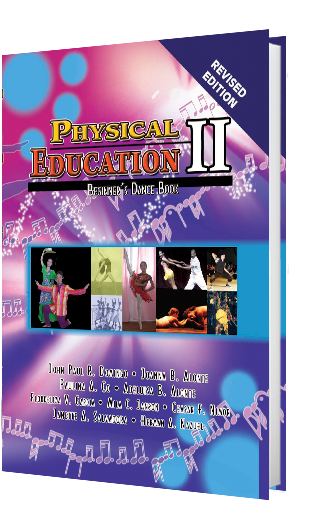
PE2 – Biñan (Revised)

Authors: John Paul R. Domingo, Joanna B. Alonte, Paulina A. Co, Adeluisa B. Alonte, Flordeliza V. Garcia, Mila C. Janson, Ceasar F. Nimor, Janette A. Salvadora, Hernan A. Nazuel

Welcome to the world of dance, one of the simplest forms of artistic expression and non-verbal communication, since it makes use of one's body as the medium. Dance is one of the best manifestations of a human being as a member of a society and is the most important vehicle to express one's culture.

Everyone can dance or has the potential to perform and it takes a simple motivation for someone to get into it. This Beginner's Dance Book could be a significant tool to motivate one to take up dancing as a hobby or as a vocation to become a dance educator. One has to simply learn the basics of dancing and these volumes of notes are designed for that purpose.

As the title of this book denotes, this is what beginners should emphasize to have a firsthand knowledge about dance.

Dance is a very vast word with abundance of meanings from its history, terms, elements, objectives, forms and positions. As the beginner starts reading the book, he will find in its earnest the information about the wide world of dance.

This book is divided into seven units, namely: Unit I: Introduction to Rhythmic Dance

Activities; Unit    The Dance Education Program; Unit III: Dance Fundamentals and Patterns; Unit IV: Folk Dance Genre; Unit V: Recreational Dance; Unit VI: Social Dance; and Unit VII: Contemporary Dance. The book also contains simple descriptions of music and tempo terms, system and manner of counting that could be useful in creating dance step combinations. Also featured in this book are authentic choreography of Philippine and Foreign Folk dances, Social and Contemporary dances with their respective historical backgrounds.

Chapter tests and practical tests are provided at the end of each chapter. This book will also help physical education teachers with no background in dance. However, teachers are advised to conduct other activities that will address the varying needs of their students and to evaluate students aptitude and performance using varied forms of instruments for reliability, accuracy, and validity.

The authors are indebted to the authors of the various sources cited in this book. We also wish to express our gratitude to Mr. Jerome M. Katipunan of the Mutya Publishing House, Inc. for his trust and confidence in us, and more specially, for the opportunity to contribute, in this humble way that we can, in the effort to better facilitate the teaching-learning process in the tertiary level. Likewise, gratitude is due to all teachers and students, who will find this book useful in their physical education classes.

It is our desire to encourage anyone with the interest, skill and dedication of getting into dance education through knowledge of the various styles of dancing, dances of the Philippines and other parts of the world. This is our humble contribution in making the student become aware of his potentials, what he can do, and what he can be; and to broaden his horizons by knowing one's culture and of other nations through more Filipino and Foreign Dances.

We hope that this book will serve its purpose to all those who love to dance.

Categories: Our Product, PE. Tags: Adeluisa B. Alonte, Biñan, Ceasar F. Nimor, College Books, Flordeliza V. Garcia, Hernan A. Nazuel, Janette A. Salvadora, Joanna B. Alonte, John Paul R. Domingo, Mila C. Janson, Paulina A. Co, PE 2 Revised, PE2.
share on
Facebook
pin this item
on Pinterest
share it on
Twitter
Send to a
friend

Related Products

  • Basic Marketing

    Author: Joanna Lynn L. Mercado

    The marketing world today is very much different from it was years ago. Today, market enterprises use modem communication technologies such as email, fax machines, Internet. World Wide Web in their marketing transactions to help making them cross boundaries with ease_ With globalization and applications of quantitative tools in marketing as the trend, modern marketing managers, marketing instructors and students have to equip themselves with modem know- how of the basic principles of marketing for them to meet the challenges in this rapid changing world of marketing.

    The primary aim of this learning material is to provide readers with a complete, precise and up-to-date explanation of the principles of marketing.

    The outline, within which the context of this material is presented, focuses mainly on the following

    Lesson 1. An overview of marketing is the concept of the first lesson. It gives the definition of marketing, the marketing mix, as well as, the 4 C's of marketing.

    Lesson 2. This part focuses on the classification of market, the concept of market segmentation, target marketing, and positioning for competitive advantage.

    Lesson 3. It explores customer behavior and characteristics. It talks about consumer buying behavior and consumer market. It also includes is the discussion on the buying behavior of the Filipino consumers.

     Lesson 4. It centers on the “product and service. The lesson presents product label and product classifications. It also covers an explanation on new product development and process, and product life cycle.

  • Art Appreciation: Looking Beyond

    Authors: Ronnie Espergal Pasigui, Fabian T. Avila, Jr., Araceli C. Suyat, Warto M. Torrevillas, and Allan V. Pura

    “Come to the edge,” he said.
    They said, “we are afraid.”
    Come to the edge,” he said.
    They came. He pushed them, and they flew.
    (Apollinaire)

    As we stand at the edge of these challenging years, gazing out into its uncharted expanse, some of us feel as if we are stepping out onto a launching pad; others feel at the brink of an abyss. Some see the challenges and the marvels to come and are exhilarated; some see only the certainty of change and its uncertain outcomes and are apprehensive. How amazing it is to note that many instructional materials, textbooks, in particular remained as they were.

    This book is a response to the challenge of writing a newer book in the humanities course. It includes features to aid the students in the understanding of the subject.

    A. Each chapter has the following features to help both the instructor and the student.1

    1. An overview of the chapter
    2. Learning objectives
    3. Key words for understanding
    4. Aids for study
    5. Exercises

    B. Chapters on the different art forms include the following features:

    1. Historical development of the art form
    2. Emphasis on Philippine art
    3. Discussion of Art and Society
    4. Inclusion of websites

    C. Optional chapters for alternative approach in teaching humanities are included:

    1. Functions Of Art (Chapter 3)
    2. Art Theories (Chapter4)
    3. Photography (Chapter 16)
    4. Discipline-based Art Education (Chapter 17)

    D. Instead of including an introductory discussion on literature as an Art, the authors focused on specific literary form— Drama. This is not to underestimate the other literary forms suck as poetry, novels, short stories, etc. Drama 15 a literary form almost within man's existence.

    E. Powerpoint Presentation of selected topics are available for teachers as supplementary materials upon request.

    These features, hopefully give this book an edge!

  • Intorduction to Microeconomics

    Authors: Olive C. Paraiso, Leonora C. Laraño, and Romeo C. Cuevas

    The purpose of this student learning material is to present an understanding of economics as an easy and enjoyable subject This learning material can be an aid to instructors and students because it presents the subject in a manner in which it can be easily understood. It could also prove useful, especially to students as a ready-made lecture notes that could save time spent in note-taking.

    Each chapter is discussed and is followed by exercises to check the students' understanding. The series of check-up questions provide students to actively participate in classroom discussions and analyses.

    Let this learning material be a guide in learning economics the easier way. This learning material be useful to all those performing in the important task of improving economic understanding and in the appreciation of subject.

    Grateful recognition is afforded to our supportive colleague for the untiring motivation with regard to the pursuit of ideals and excellence in extracting ideas and thoughts from both the teaching force and the students.

Copyright © Mutya Publishing House, Inc. All Rights Reserved, 2020