
-
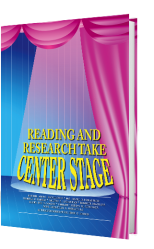
Reading and Research take Center Stage
Authors: Bethel Ann C. Batallones, Ma. Hazel B. Forastero, Nerissa C. Cabello, Arlene E. Lumantao, Rommel Maglaya, Glory Dee D. Magno, Emilou Lindsay M. Mendoza, Noel Christian A. Moratilla
Authors/Coordinator: Irish C. Sioson
As a sequel to “Spotlight: Study, Thinking and Writing Skills”, this book aims to further hone students' reading and writing skills situated in the research context. Reading and Research Take Center Stage is designed to reinforce and strengthen critical thinking and research skills of budding researchers as they face the various research-based tasks the academic and professional world demand. This book, which is a product of careful research, further aims to instil the values of scientific inquiry, sense of responsibility and discipline research entails. Emphasizing on the importance of research, the modules contained in this book guide the students to walk through the process of research and help them to recover, discover, rediscover, refine, define, or refine personal, social, economic, gender, environment and professional issues as reflected in the research articles coming from different disciplines.
This purposive part includes specific primary and secondary skills which are clearly and concisely articulated to help set goals for the readers.
This exciting starter warms up, encourages and stimulates readers' curiosity a varied and enjoyable activities are included to introduce the topics and prepare ther for the lesson.
This priceless part serves as a bridge to the Audition and the actual reading selection by linking the preparatory activities and the subject being investigated by the research article through previewing the text.
This extraordinary element prepares the reader for a closer reading of the text as students are engaged in a dialogue with the text/ author through annotation and effective note taking.
This special section provides explicit input for the focus reading skill, emphasizing specific strategies to demonstrate and develop the necessary skill for thinking, reading, and research.
Rehearsal
This practical part encourages collaboration between and among students as they are guided by their instructor in practicing or rehearsing the skills to prepare them for independent work eventually.
Performance
This super section provides challenging and engaging opportunities for individual and collaborative application of reading and research skills presented.
Encore
This section promotes careful and thoughtful reflection among readers to ponder on their strengths, progress and areas for improvement. This helps them become more self-directed and metacognitive learners.
Various performance-based rubrics are also provided to ensure effective assessment of students' processes and outputs to aid students monitor their own learning and guide educators supplement and design instruction.
-

Rizal
Authors: Jensen DG. Mañebog, Pedrito B. Placio, Rodrigo DP. Tomas, Rafael Y. Paragas, Nirvana SG. Bides
Editor: Jensen DG. Mañebog
HISTORY IS COMMONLY DEFINED as a story about the past that is significant and true. Admittedly Jose Rizal is an item of the 'past'. Arguably nonetheless, the known information about his life, works, and writings—which can be proved `true' based on preserved 'relics' and artifacts—are significant even to present generation.
History subjects like Rizal can be meaningful and practicable though it largely depends on the teacher presenting the subject and the instructional materials used. Pertinently one of the humble aims of this book is to introduce the course in such a way that the teacher and students alike would find it interesting and meaningful.
This book possesses the following distinctive features:
1. Includes new researches
In light of recent findings, this book, for instance, discusses what happened to Josephine Bracken, Paciano, Dona Teodora, Rizal's other siblings, and other relevant Filipino heroes after Rizal's martyrdom.
Clarifies some controversies and discrepancies
Many sections deal with historical controversies like whether or not Rizal indeed graduated as 'valedictorian' in Ateneo (as some references claim) and whether or not he did write the poem `Sa Aking Mga Kabata'.
Advocates c-learning and blended learning
It contains interesting 'interactive online activities' and suggests supplemental online readings. Connectedly, the hook is compatible with online education program.
With analyses, comments, and applications
Whenever appropriate and needed, significant remarks and relevant supplemental information are embedded in the lectures. Some lectures also state the relevance, value, and applicability of the topics to our lives.
Uses blog and feature-article format
To be appealing to young generations, some lectures somewhat deviate from the traditional too formal (like straight news) style. Instead, they are written the way blogs and online articles are.
Features other Filipino heroes
As many schools are now including other Filipino heroes in the syllabus for the Rizal subject, this book pertinently features many of them (e.g. Del Pilar, Bonifacio, and Aguinaldo as it identifies Rizal's relations and collaborations with them.
-
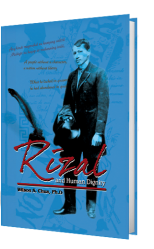
Rizal and Human Dignity
Authors: Wilson S. Chua, Ph.D
Our country had been set apart to have a hero in the person of Dr. Jose Rizal, At the tender age of eight, he was already aware of the importance of nationalism and began honing his artistic talents for the country, as can be seen in his first poem “Sa Aking mga Kabata”. Although extraordinarily gifted, Rizal chose not to enrich himself with his God-given talents but instead try to uplift our country by reaching out to Filipinos through his writings. Each one of Rizal's work of art is a masterpiece, filled with human values, ideas, lessons, and principles that were deeply embedded within him. His works are timeless, the messages they convey still touch the lives of modern Filipinos just as they have touched the Filipinos during the Spanish era, filling their hearts with love for the country.
Included within these pages are some of Rizal's best poems and essays, every one of them filled with meaningful messages with which will enlighten and encourage the Filipinos who will read them to love and serve the country. With this purpose in mind, each literary piece featured here is accompanied by information as to when, where, and why it was written by Dr. Jose Rizal. Written commentaries by distinguished personalities are also presented for each literary piece. Furthermore, much effort had been exerted and diligence in presenting the various ideas and values that Rizal had been implanted within his poems and essays.
Let this short journey into the mind of Rizal through his poems and essays bear fruit in the lives of the readers, enriching them not only with fortitude but excellence and uprightness as a person. With every glimpse of Rizal's person mirrored in his words, let us not forget that there was once a man whose dreams were dedicated to the Philippines. His every labor was for the betterment of the Filipinos; his death was for the glory of the country. Let us stand witness to the greatness of the man called Dr. Jose P. Rizal.
-
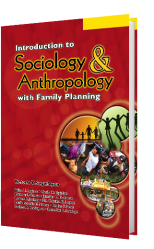
Sociology and Anthropology with Family Planning 2011 (Saquilayan)
Authors: Felisa U. Aguirre, Cecile D. Espiritu, Miramar I. Garcia, Jennifer M. Hobrero, Romeo R. Javines, Ma, Cristina D. Lopez, Maria Rosario E. Monce, Berlyn F. Pa-at, Evalyne A. Rodriquez, Benedict B. Santiago
Sociology and Anthropology are exciting as well as challenging fields of scientific study. It is exciting because it is dynamic and challenging because it opens up a lot of avenues for a continuing knowledge and understanding about the world, people and events. It is about people who are engaged in daily and non-stop activity.
As part of this life activity, this compendium is designed to sere as an introductory material on Sociology and Anthropology. Both scientific fields. although comparatively young in the academic world have been regarded not only as beneficial but moreso, very essential in the preparatory stage of one's understanding about life and the surrounding environment.
The immensity of the subject on both fields of study is given. May this compendium aid the students through their teachers as they engage themselves in this study.
-
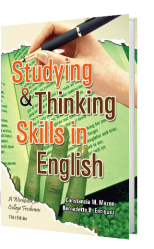
Studying and Thinking Skills in English
Authors: Constacia M. Mazon, Bernadette B. Enriquez
YOUR STUDYING AND THINKING task here is meant to enhance your communication skills in English for you to cope effectively with your academic requirements. The lessons and activities are designed to make you achieve the desired enhancement These are composed and developed into nine chapters.
The first chapter is about paving the way to an enhanced studying and thinking skills in English — focusing on getting an overview of the course through the syllabus, using the library, taking down notes, and honing critical and creative thinking.
The second chapter is about enhancing studying and thinking skills to cope with the demands of an examination before, during, and after taking it. ft focuses specifically or coping with the given instructions and on answering the questions asked in A.
The third chapter is about identifying and stating a fact and an opinion and on identifying and drawing out an inference.
The fourth chapter is all about enhancing studying and thinking skills towards effective reading in English.
The fifth chapter i ail about enhancing studying and thinking skills in English towards reading with comprehension essays, short stories, drama, and poems.
The sixth chapter is about enhancing studying and thinking skills towards effective writing and speaking in English.
The seventh chapter is about enhancing studying and thinking skills towards unity, coherence, and emphasis in developing and organizing ideas.
The eighth chapter is ail about enhancing studying and thinking skills in English towards effective development and organization of ideas in speaking and writing.
And the ninth chapter is about enhancing studying and thinking skills in English towards writing a good paragraph, essay, summary, and paraphrase.
Each lesson gives the nature of the studying and thinking work to be done and some techniques that can be used for the task to be done more efficiently.
Overall, this program of lessons is your writer's well-meant response to the syllabus suggested for use in tertiary English One by the Commission on Higher Education (CHED).
-

Values Education
Authors: Ma. Kathleen C. Tiglao, Ph.D., Georadelia T. Lungay, RGC, Piere John H. Caliao, MA. Ed., Philip Albert Y. Lagahid, MA
School is one of the agents from where the personality of human individual would form, it might not be the sole influence but it contributes a lot to the life of an individual since, the basic education system of our country requires the individual to stay in school more than 8 hours a day, 5 times a week_ Through this, one might showcase his/her identity from where he/she is coming and what culture does it bring. Thus, everyone should have the same culture and values as Filipino people who are living in the same country.
This work/textbook is one of the tools that will help educators, parents and leaders in instilling values to young individuals, most especially the students. Though the parents are the first teacher of values to their children, we can hardly deny the fact that every parent have their own ways and practices of their values.
The content of this work/textbook focuses on the human seven core values namely: Truth, Spirituality, Love, Economic Efficiency, Health. Patriotism and Nationalism, and Social Responsibility. From these core values, good Filipino values were formed and developed which means these are the sources of all Filipino values that we have. By knowing these values, we are able to really understand why we have such practices that other countries do not have and why there is belief that other countries do not have. Aside from knowing these values, we will also be informed that we have to, as well, become cognizant of their negative effects on individuals and on others.
The following chapters will give a short and concise practical explanation on the seven (7) core values that Filipino people have. Each chapter contains pre-activity, post-activity and post evaluation as well. The pre-activity will check the students' existing knowledge, practices and beliefs that they have on a specific value. The post activity after every discussion will check the learning experience of the students. While the post-evaluation makes the students reflect on how they are going to apply it to themselves, affect other people and improve the community in their own way.