Mutya Publishing House, Inc.
  • Home
  • Our Product
    • Filipino 1
    • Filipino 2
    • Filipino 3
    • Other Filipino
    • English 1
    • English 2
    • English 3
    • English 4
    • English Major
    • PE
    • Ethics
    • History
    • Computer
    • Philosophy
    • Psychology
    • Rizal
    • Science
    • Sociology
    • HRM
    • Spanish
    • Math
    • Drawing
    • Business
    • Humanities
    • NSTP
    • Logic
    • Others
  • About Us
  • Contact Us
  • Self-learning Modules
Prev
  / 
Next

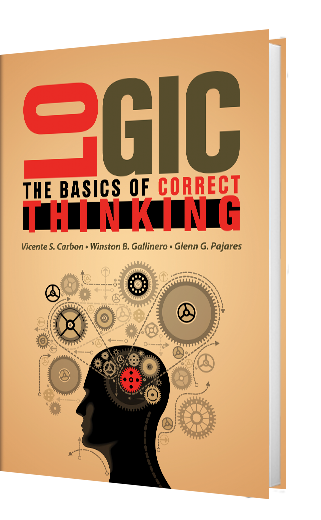
Logic The Basics of Correct Thinking

Authors: Vicente S. Carbon,  Winston B. Gallinero,  Glenn G. Pajares

There are many literatures concerning Logic that present the basics of correct thinking such as simple apprehension, understanding terms and concepts, judgments and propositions, the kinds of inference, and the kinds of fallacies. However, only a few books provide an overview of philosophy vis-à-vis logic, and the relevance of Logic to other disciplines and in our day-to-day living.

This book provides the readers with an overview of philosophy in relation to Logic and the relevance of Logic to other disciplines such as the rigorous and the social sciences, and most importantly in our day-to-day living.

One of the unique features of this book is that in discussing the significance of Logic, the different schools of thought such as Platonic, Materialism, Aristotelian and Oriental are given overviews. The overviews are supplemented with Euler diagrams and a combination of Euler and Venn diagrams so that the readers will have vivid pictures of the schools of thought through symbols.

Another unique feature of this book is that it presents and clarifies in Module I the basic laws and principles governing correct thinking. This is very important because at the outset of the study of correct thinking, the readers are already aware of and will be guided by the foundational norms of classical logic.

The basic laws and principles governing correct thinking like the basic law on the truth of the antecedent and its consequent and the basic principles like the principle of identity and the principle of contradiction, among others, are further clarified in Module Ill concerning judgments and propositions. Moreover, these laws and principles are applied intensively in Module V concerning immediate inference and in Module VI which deals with mediate inference. Euler diagrams and Venn diagrams are also presented to supplement and clarify further the illustrative examples of the inferences.

But the most unique feature of this book is its constructive critique of the errors of some popular authors of Logic book by presenting and rectifying the errors such as the erroneous use of Venn diagrams which is dealt with in Module V, the erroneous classification of some fallacies into fallacies not of language or non-linguistic fallacies which is dealt with in Module VII.

Through the unique features of this book with emphasis to the last one, the authors fervently hope that the readers may realize also some insights like to simplify complex concepts and principles is far different from a simplistic discussion, having a broad and open mind is far better than having a myopic and close mind, and to detect an error is good but to constructively rectify it is better.

Enjoy reading and learning!

Categories: Logic, Our Product. Tags: College Books, Glenn G. Pajares, Logic, Logic The Basics of Correct Thinking, Vicente S. Carbon, Winston B. Gallinero.
share on
Facebook
pin this item
on Pinterest
share it on
Twitter
Send to a
friend

Related Products

  • Art Appreciation: Looking Beyond

    Authors: Ronnie Espergal Pasigui, Fabian T. Avila, Jr., Araceli C. Suyat, Warto M. Torrevillas, and Allan V. Pura

    “Come to the edge,” he said.
    They said, “we are afraid.”
    Come to the edge,” he said.
    They came. He pushed them, and they flew.
    (Apollinaire)

    As we stand at the edge of these challenging years, gazing out into its uncharted expanse, some of us feel as if we are stepping out onto a launching pad; others feel at the brink of an abyss. Some see the challenges and the marvels to come and are exhilarated; some see only the certainty of change and its uncertain outcomes and are apprehensive. How amazing it is to note that many instructional materials, textbooks, in particular remained as they were.

    This book is a response to the challenge of writing a newer book in the humanities course. It includes features to aid the students in the understanding of the subject.

    A. Each chapter has the following features to help both the instructor and the student.1

    1. An overview of the chapter
    2. Learning objectives
    3. Key words for understanding
    4. Aids for study
    5. Exercises

    B. Chapters on the different art forms include the following features:

    1. Historical development of the art form
    2. Emphasis on Philippine art
    3. Discussion of Art and Society
    4. Inclusion of websites

    C. Optional chapters for alternative approach in teaching humanities are included:

    1. Functions Of Art (Chapter 3)
    2. Art Theories (Chapter4)
    3. Photography (Chapter 16)
    4. Discipline-based Art Education (Chapter 17)

    D. Instead of including an introductory discussion on literature as an Art, the authors focused on specific literary form— Drama. This is not to underestimate the other literary forms suck as poetry, novels, short stories, etc. Drama 15 a literary form almost within man's existence.

    E. Powerpoint Presentation of selected topics are available for teachers as supplementary materials upon request.

    These features, hopefully give this book an edge!

  • Intorduction to Microeconomics

    Authors: Olive C. Paraiso, Leonora C. Laraño, and Romeo C. Cuevas

    The purpose of this student learning material is to present an understanding of economics as an easy and enjoyable subject This learning material can be an aid to instructors and students because it presents the subject in a manner in which it can be easily understood. It could also prove useful, especially to students as a ready-made lecture notes that could save time spent in note-taking.

    Each chapter is discussed and is followed by exercises to check the students' understanding. The series of check-up questions provide students to actively participate in classroom discussions and analyses.

    Let this learning material be a guide in learning economics the easier way. This learning material be useful to all those performing in the important task of improving economic understanding and in the appreciation of subject.

    Grateful recognition is afforded to our supportive colleague for the untiring motivation with regard to the pursuit of ideals and excellence in extracting ideas and thoughts from both the teaching force and the students.

  • Humanities Art Appreciation

    Authors: Ricardo A. Clores, Jeffrey A. Lubang, Mary Ann J. Salvador, Virginia T. Sanfilip, and Jovito R. Santos Jr.

    Where do we put the humanities and the arts in a nation that budges and prods its students, like a mantra recited on a daily basis, to take skilled works? Today, the demands of the First World markets are nurses, caregivers and call center agents. Tomorrow, First World needs might shift to hotel and restaurant management practitioners, plumbers, electricians, automechanics and the like. As the country sinks deeper in its economic woes, at the same time tightens its grip even more to First World needs, students are left with no other choice but to submit. Not that there is anything wrong with being a caregiver or a call center agent, if this is what a student truly wants, but the condition paints even more of the pathetic and dwindling opportunities and possibilities for Filipino students.

Copyright © Mutya Publishing House, Inc. All Rights Reserved, 2020