Mutya Publishing House, Inc.
  • Home
  • Our Product
    • Filipino 1
    • Filipino 2
    • Filipino 3
    • Other Filipino
    • English 1
    • English 2
    • English 3
    • English 4
    • English Major
    • PE
    • Ethics
    • History
    • Computer
    • Philosophy
    • Psychology
    • Rizal
    • Science
    • Sociology
    • HRM
    • Spanish
    • Math
    • Drawing
    • Business
    • Humanities
    • NSTP
    • Logic
    • Others
  • About Us
  • Contact Us
  • Self-learning Modules
Prev
  / 
Next

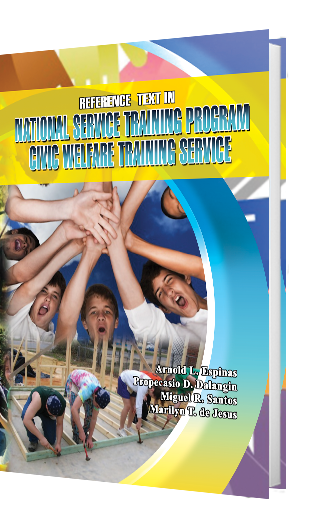
National Service Training Program Civic Welfare Training Service

Authors: Arnold L. Espinas,  Propecasio D. Dalangin,  Miguel R. Santos,  Marilyn T. de Jesus

This reference text is a result of a long search for the appropriate materials for the Civic Welfare Training Service (CWTS). One of the principal aims of the NSTP is to instill in the minds of the young Filipinos the culture of volunteerism. But developing a high sense of volunteerism is not enough to make the young citizens become effective agents of development. In order to become an effective community worker, each student of CWTS must possess not only the ability to identify the problems of a community. He must also exhibit the ability to understand causes and effects of those problems which will provide great help in formulating the kind of intervention needed to confront them.

The task of student community workers is not easy, especially on the part of those still in the process of gaining accurate perspective of the dynamics of the community. Each community is characterized by various complexities of sociocultural realities. That is indeed the reason why the authors believe that there can never be one written material capable of providing complete answers to the issues of even one community. But even so, this reference text hopes to share relevant information that will encourage young individuals to become empowered members of the society to which they belong. Empowerment would mean being always ready to initiate actions instead of just being plain participants in any community building efforts.

Categories: NSTP, Our Product. Tags: Arnold L. Espinas, College Books, Marilyn T. de Jesus, Miguel R. Santos, NSTP, Propecasio D. Dalangin.
share on
Facebook
pin this item
on Pinterest
share it on
Twitter
Send to a
friend

Related Products

  • Reading and Research take Center Stage

    Authors: Bethel Ann C. Batallones,  Ma. Hazel B. Forastero,  Nerissa C. Cabello,  Arlene E. Lumantao,  Rommel Maglaya,  Glory Dee D. Magno,  Emilou Lindsay M. Mendoza,  Noel Christian A. Moratilla

    Authors/Coordinator: Irish C. Sioson

    As a sequel to “Spotlight: Study, Thinking and Writing Skills”, this book aims to further hone students' reading and writing skills situated in the research context. Reading and Research Take Center Stage is designed to reinforce and strengthen critical thinking and research skills of budding researchers as they face the various research-based tasks the academic and professional world demand. This book, which is a product of careful research, further aims to instil the values of scientific inquiry, sense of responsibility and discipline research entails. Emphasizing on the importance of research, the modules contained in this book guide the students to walk through the process of research and help them to recover, discover, rediscover, refine, define, or refine personal, social, economic, gender, environment and professional issues as reflected in the research articles coming from different disciplines.

    This purposive part includes specific primary and secondary skills which are clearly and concisely articulated to help set goals for the readers.

    This exciting starter warms up, encourages and stimulates readers' curiosity a varied and enjoyable activities are included to introduce the topics and prepare ther for the lesson.

    This priceless part serves as a bridge to the Audition and the actual reading selection by linking the preparatory activities and the subject being investigated by the research article through previewing the text.

    This extraordinary element prepares the reader for a closer reading of the text as students are engaged in a dialogue with the text/ author through annotation and effective note taking.

    This special section provides explicit input for the focus reading skill, emphasizing specific strategies to demonstrate and develop the necessary skill for thinking, reading, and research.

    Rehearsal

    This practical part encourages collaboration between and among students as they are guided by their instructor in practicing or rehearsing the skills to prepare them for independent work eventually.

    Performance

    This super section provides challenging and engaging opportunities for individual and collaborative application of reading and research skills presented.

    Encore

    This section promotes careful and thoughtful reflection among readers to ponder on their strengths, progress and areas for improvement. This helps them become more self-directed and metacognitive learners.

    Various performance-based rubrics are also provided to ensure effective assessment of students' processes and outputs to aid students monitor their own learning and guide educators supplement and design instruction.


  • Programming 1 Worktext in ITC-02

    Authors: Rodibelle F. Leona,  Rodella F. Salas,  Henry T. Roque,  Emerson M. Angellano

    Programming 1, WorkText in ITC-02 was created to enable Information Technology students understand the basics of programming using the C++ Language. It is designed in such a way that the context of the language can be easily comprehended by the students with less of the jargons of a computer language.

    The authors discussed the programming concepts thatwill introduce the students to the world of programming. They tackled the components of the computer system, the steps used in programming, the elements and the programming paradigms. The second chapter deals mainly in the history of Programming Languages where the Control Structures and Flowcharts are also discussed. This WorkText also included the discussion about Code:Blocks, its parts and functions.

    The WorkText also has a comprehensive discussion about the identifiers and data types, the operations that can be used in programming (mathematical, relational and logical) and assignment statements. The simple Input/Output commands are also given ample discussions.

    The last part is consist of the decision making structure wherein data is subjected to comparison and the course of action of the program will be based on the value of the comparison.

    Seatworks and Laboratory Exercises are also included in this WorkText so that students will be able to apply what they have learned through the discussions.


  • Basic Drawing 2

    Author: Erich D. Cruz

    This workbook is an edition specially prepared to completely encompass the syllabus in Drawing 2 of the First Year – Bachelor of Technology, Engineering and other related courses with various specializations.

    This course provides the students with rudiments of working drawing. This enables the students to apply fundamental principles learned in introductory drawing.

    The subject covered two parts: 1) First, it deals with the review of Orthographic and Pictorial Drawings. At this stage, while grasping the fundamentals of multi-view projections and pictorial drawings, more stress should be laid on accuracy, precision and neatness. Speed, which is also an essential requirement, can be achieved with constant practice. 2) Second, it deals mainly with the principles of dimensioning, scaling, sectioning, auxiliary views and pattern & surface development and their applications to simple machine parts for the purpose of their vivid description.

    This is completely prepared so as to conform to the current practices of length measurement and projection system.

    Practice exercises have been added purposely for drawing interpretations.

    The author strongly believed the students will benefit immensely with the proper use of this workbook.

Copyright © Mutya Publishing House, Inc. All Rights Reserved, 2020