Mutya Publishing House, Inc.
  • Home
  • Our Product
    • Filipino 1
    • Filipino 2
    • Filipino 3
    • Other Filipino
    • English 1
    • English 2
    • English 3
    • English 4
    • English Major
    • PE
    • Ethics
    • History
    • Computer
    • Philosophy
    • Psychology
    • Rizal
    • Science
    • Sociology
    • HRM
    • Spanish
    • Math
    • Drawing
    • Business
    • Humanities
    • NSTP
    • Logic
    • Others
  • About Us
  • Contact Us
  • Self-learning Modules
Prev
  / 
Next

Logic A foundation of Critical Thinking

Authors: Jensen DG. Mañebog,  Jeremias F. Buraga,  Rafael Y. Paragas,  Ma. Rubeth R. Hipolito

BECAUSE THINKING CORRECTLY is an integral part of who we are as human beings, the idea of helping people develop their reasoning ability involves expanding who they are as rational beings. This is one of the many reasons teaching a course in Logic and Critical Thinking is perpetually exciting and gratifying.

Teaching students the subject Logic is equipping them with useful intellectual tools which also refine their viewpoint from which they view the world. As Logic also calls for the need to evaluate and persistently reassess one's concepts and even values, this academic discipline, in effect, aptly guides people in making wise decisions in life. Moreover, clear understanding of many things oftentimes leads to properly looking at the world and life itself. The dictum thus resounds: Logic, as is the case with other branches of Philosophy, may not teach us how to make a living, but it could teach us that life is worth living.

This book in Logic is written to serve as a comprehensive introduction to reasoning and Critical Thinking. It humbly aims to help the readers develop thinking abilities needed for academic study and career success as it fosters relatively advanced intellectual and language abilities.

Features of this Book

This book possesses various features that make it an effective tool for both instructor and students. This book is

  1. Logically Arranged. It begins with the basic things about Logic and Critical Thinking and then sequentially progresses to more sophisticated thinking—the critical evaluation of terms, propositions, and arguments, respectively.
  2. Written in Module Form. Each lecture comes with other important elements like objectives, discussions, activities, self-tests, and the like which make each module a holistic learning package.
  3. A Simplified Easy-to-Read Logic Book. Though simplifying Philosophy lectures is experientially easier said than done mission, this book nonetheless endeavores for this objective as it also contains other attributes that make the lectures reader-friendly. Whenever appropriate, sections are written in conversational tone using the `you' and 'we' pronouns as if talking to the readers. Furthermore, sensible and easy-to-understand examples are carefully chosen for each topic.
Categories: Logic, Our Product. Tags: College Books, Jensen DG. Mañebog, Jeremias F. Buraga, Logic, Logic A foundation of Critical Thinking, Ma. Rubeth R. Hipolito, Rafael Y. Paragas.
share on
Facebook
pin this item
on Pinterest
share it on
Twitter
Send to a
friend

Related Products

  • Art Appreciation: Looking Beyond

    Authors: Ronnie Espergal Pasigui, Fabian T. Avila, Jr., Araceli C. Suyat, Warto M. Torrevillas, and Allan V. Pura

    “Come to the edge,” he said.
    They said, “we are afraid.”
    Come to the edge,” he said.
    They came. He pushed them, and they flew.
    (Apollinaire)

    As we stand at the edge of these challenging years, gazing out into its uncharted expanse, some of us feel as if we are stepping out onto a launching pad; others feel at the brink of an abyss. Some see the challenges and the marvels to come and are exhilarated; some see only the certainty of change and its uncertain outcomes and are apprehensive. How amazing it is to note that many instructional materials, textbooks, in particular remained as they were.

    This book is a response to the challenge of writing a newer book in the humanities course. It includes features to aid the students in the understanding of the subject.

    A. Each chapter has the following features to help both the instructor and the student.1

    1. An overview of the chapter
    2. Learning objectives
    3. Key words for understanding
    4. Aids for study
    5. Exercises

    B. Chapters on the different art forms include the following features:

    1. Historical development of the art form
    2. Emphasis on Philippine art
    3. Discussion of Art and Society
    4. Inclusion of websites

    C. Optional chapters for alternative approach in teaching humanities are included:

    1. Functions Of Art (Chapter 3)
    2. Art Theories (Chapter4)
    3. Photography (Chapter 16)
    4. Discipline-based Art Education (Chapter 17)

    D. Instead of including an introductory discussion on literature as an Art, the authors focused on specific literary form— Drama. This is not to underestimate the other literary forms suck as poetry, novels, short stories, etc. Drama 15 a literary form almost within man's existence.

    E. Powerpoint Presentation of selected topics are available for teachers as supplementary materials upon request.

    These features, hopefully give this book an edge!

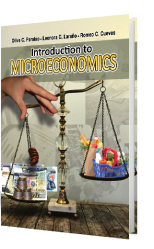
  • Intorduction to Microeconomics

    Authors: Olive C. Paraiso, Leonora C. Laraño, and Romeo C. Cuevas

    The purpose of this student learning material is to present an understanding of economics as an easy and enjoyable subject This learning material can be an aid to instructors and students because it presents the subject in a manner in which it can be easily understood. It could also prove useful, especially to students as a ready-made lecture notes that could save time spent in note-taking.

    Each chapter is discussed and is followed by exercises to check the students' understanding. The series of check-up questions provide students to actively participate in classroom discussions and analyses.

    Let this learning material be a guide in learning economics the easier way. This learning material be useful to all those performing in the important task of improving economic understanding and in the appreciation of subject.

    Grateful recognition is afforded to our supportive colleague for the untiring motivation with regard to the pursuit of ideals and excellence in extracting ideas and thoughts from both the teaching force and the students.

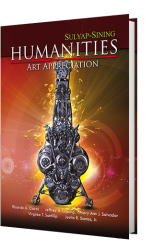
  • Humanities Art Appreciation

    Authors: Ricardo A. Clores, Jeffrey A. Lubang, Mary Ann J. Salvador, Virginia T. Sanfilip, and Jovito R. Santos Jr.

    Where do we put the humanities and the arts in a nation that budges and prods its students, like a mantra recited on a daily basis, to take skilled works? Today, the demands of the First World markets are nurses, caregivers and call center agents. Tomorrow, First World needs might shift to hotel and restaurant management practitioners, plumbers, electricians, automechanics and the like. As the country sinks deeper in its economic woes, at the same time tightens its grip even more to First World needs, students are left with no other choice but to submit. Not that there is anything wrong with being a caregiver or a call center agent, if this is what a student truly wants, but the condition paints even more of the pathetic and dwindling opportunities and possibilities for Filipino students.

Copyright © Mutya Publishing House, Inc. All Rights Reserved, 2020