Mutya Publishing House, Inc.
  • Home
  • Our Product
    • Filipino 1
    • Filipino 2
    • Filipino 3
    • Other Filipino
    • English 1
    • English 2
    • English 3
    • English 4
    • English Major
    • PE
    • Ethics
    • History
    • Computer
    • Philosophy
    • Psychology
    • Rizal
    • Science
    • Sociology
    • HRM
    • Spanish
    • Math
    • Drawing
    • Business
    • Humanities
    • NSTP
    • Logic
    • Others
  • About Us
  • Contact Us
  • Self-learning Modules
Prev
  / 
Next

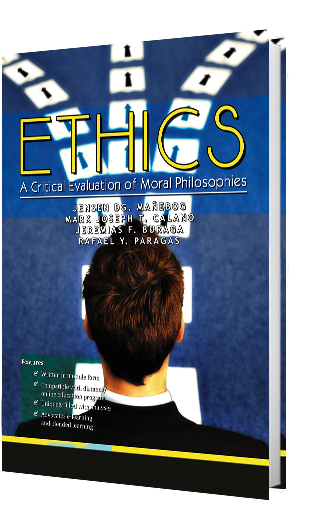
Ethics

Authors:  Jensen DG. Mañebog, Mark Joseph T. Calano, Jeremias F. Buraga, Rafael Y. Paragas

HAVING A SENSE of morality is one of the things that differentiates us from animals. By nature, we are sincerely concerned with what is right and what is wrong in human behavior. Unlike animals, we care about living out ethical principles.

Since we can elicit abstract concepts such as truth, righteousness, and goodness, reflection about morality has been an essential element of human civilizations. Around the world, people ask basic moral questions such as, “What is the good?” “What makes a life a good life?” “What are the virtues of a human being?” and “What duties do we have to each other?”

A course in Ethics is thus undoubtedly fundamental and necessary. The subject significantly helps in endorsing valuable moral and social values like cooperation, social responsibility, respect for human rights, compliance with the law, and peace preservation. As Ethics calls for rational and righteous living, it encourages making good choices and living a purposeful and meaningful life.

ETHICS: A Critical Evaluation of Moral Philosophies was written to serve as a comprehensive introduction to the study of morality and ethical evaluation. It humbly aims to help the readers develop a conscious ethical sense and become critical in choosing a moral philosophy to live by.

Some Features of this Book:

This book possesses various features that make it an effective tool for both instructor and students:

  1. Written in module form. Each lecture comes with other important elements like objectives, discussions, activities, self-tests, and others which make each module a holistic learning package.
  2. Compatible with distance/online education program. Having ample experience in teaching under distance learning program, the authors also designed this book for online students. Modular in form, the book is self-taught so students can also advance at their own pace. Online students' responses to activities, self-tests and discussions may be sent to their respective professors through e-mail.
  3. Uniquely filled with analyses. Unlike many Ethics books, its modules do not only present and explain the various moral philosophies but also critically evaluate them by deeply examining them in detail.
  4. Advocates e-learning and blended learning. When adopted by professors, many instructions under Activities will allow students to further learn from additional online lectures which were already screened and filtered by the authors. Some activities are even programmed to let the students experience engaging in intellectual discussions with other people anywhere in the world online.

To the Professors:

If used creatively, this book could also integrate the development of thinking abilities with the four language skills so crucial to success in college and careers: reading, writing, speaking, and listening. Through thought-provoking readings, writing assignments (answering questions in the 'discussions,' reaction papers, and essays), and discussion exercises, students can improve their language skills.

Each module is purposely designed to comprise the following parts:

  1. A set of specific objectives which allows readers to anticipate the concepts, principles or skills they will learn in the module.
  2. The lecture proper which presents and discusses in details the topics.
  3. The analysis part where the critical evaluation and appraisal of the ethical theory could be read.
  4. Discussions which contain questions and guide topics professors can use during lectures, or for recitation and evaluation. These lead the students to further internalize the subject matter.
  5. Activities which provide students with means through which they can further internalize the topic or experience how the concepts can be applied. These can also serve as pre-lecture or post-lecture homework, or classroom task when the professor could not attend class.
  6. Self-tests which measure how well the students comprehend the lecture. Professors may use them for evaluation (quiz, pre-test, etc.).
  7. Professors under distance learning program may supplement this book, for instance, by providing a calendar of deadlines on which online students have to submit their responses (answers to self-test, reactions to discussions, products for activities, etc.).
  8. Ultimately, professors arc free to treat each module either as a self-contained unit or as a launch pad to other teaching-learning processes.
  9. To the Students:
  • This book is designed to help you become knowledgeable and critical about various moral theories. Hopefully, this could also help you become better in reasoning skill, a quality which you can subsequently apply to your other academic subjects and various facets of life. The lectures, moreover, call for you to provide context for the topics by eventually considering them in forming or modifying your personal beliefs and principles.
  • To online students, you should treat this book as your personal tutor. By dedicatedly reading the lectures and faithfully accomplishing all the things required by your assigned professor, you can teach yourself the necessary knowledge and skills related to Ethics. Remember that those competencies cannot be acquired by unintelligently subscribing to 'cut-and-paste' malpractice in accomplishing your tasks and assignments.
  • To all students, if you wish to benefit much from this Ethics book, you should be ready to dedicate as much time as necessary. Taking this book seriously will help you transform into an intellectually mature, creative, and responsible moral person.
Categories: Ethics, Our Product. Tags: College Books, Ethics, Jensen DG. Mañebog, Jeremias F. Buraga, Mark Joseph T. Calano, Rafael Y. Paragas.
share on
Facebook
pin this item
on Pinterest
share it on
Twitter
Send to a
friend

Related Products

  • Physics 1 Lab Manual

    Authors: Irin M. Malajito, Mara Crisaliz B. Paras, Myra S. Ferrer

    This laboratory manual has been created to substantiate the concepts being presented during the lecture in Physics 1. It would be most beneficial if a particular theory will be presented to the students before an experiment is performed. The procedures in this manual are detailed, constructed step.by-step in order for the students to be independent in their performance of the experiment. The application questions link the concepts of physics with everyday scenario for better retention, and with industry practices in order to create mindset among students of their future tasks. The exercises will enhance the skills of the students in problem solving.

    OBJECTIVES OF PERFORMING THE ACTIVITY IN PHYSICS

    Laboratory work is designed to:

    familiarize students with the fundamental principle of the subject firsthand manipulation of apparatus and personal application of the principle studies.

    train students with the methods and thoughtful experience in experimentation, careful observation and honest recording of data, critical analysis, correlation and interpretation of experimental data

    familiarize students in the use of laboratory apparatus and techniques used in physical measurements

    train students in making valid and worthwhile conclusion from observed data.

  • Biological Science (Cajuday)

    Authors: Lilibeth A. Cajuday, Anne R. Dioneda, Carlo F. Galias, Jonathan Jaime G. Guerrero, Charmaine A. Malonzo, Phil V. Morano, Joan R. Nace, Jocelyn E. Serrano

    Teaching a pure science to non-science majors is a hard task. Teachers are faced with the challenging problem of explaining the complex structures of cells or the intricate chemical pathways in a simple and, in a sense, artful way. Vis-a-vis this simplicity is not losing the basic concepts. Striking a balance takes up a lot of creativity, of board and seat works, and other methodologies to bring home the message to students.

    Finally, this book creates another stepping stone in understanding the science of life. Unlike other textbooks, this Biological Science reference material takes into consideration the actual semestral time frame. It is equipped not just to teach directly but also to encourage self-exploration and culture of research. Besides, a university is a university because it is a generator of knowledge through a prolific research culture among students.

    Given this, it is the hope of the authors that this book serves its purpose. The study of biology is an interesting field regardless of background or skills and competencies. It is perhaps the most practical among the many branches of science. It does not talk about things too farfetched or blurred. It talks about our very self. We, you are the best manifestation of life. Thus, this book is about you, a narration of our physicalities and an explanation of our biological being.

  • Biological Science (Caballes)

    Authors: Dennis G. Caballes, Jennifer S. Florida

    The concept approach of the book is suitable for undergraduate non-Biology major students. The book is designed to be useful workbook for students enrolled in Biology subject. It is divided into eight units which cover major topics such as cell biology, genetics, evolution, ecology, biological diversity and plant and animal biology. Each part has balanced coverage of all topics sufficient for a semester-long course in Biology. The authors considered these topics as important pans of biology which will provide the core knowledge in science.

    The opening unit of the book gives an overview of how the field of Biology is studied and explored using scientific method. Unit II deals with biological molecules that account for the structure, function and even the origin of cells. The next unit provides discussion on energy and metabolism which is the central phenomena in the study of biological organisms. It is followed by the study of heredity and the evolutionary process in the heritable characteristics (Unit IV). Basic ecology concepts are introduced in Unit V while biodiversity is main focus of discussion of Unit VI. The last unit deals with plant and animal biology. Each chapter included in every unit is provided with self-assessment part which includes quick recall questions and questions that elicit critical thinking. Moreover, helpful materials that would reinforce learning are appended towards the end in an effort to provide additional information among the users of this book. Furthermore, laboratory exercises are incorporated for each chapter in order to supplement the concepts learned in the lecture and to make them responsible in their own learning through manipulation and discovery.

    The authors of this book have been friends and colleagues for several years and, while they have often discussed writing a book together, the timing never seemed quite right. Finally, they put their heads together to come up with a “generic” book suitable for non-science students with different major and coming from various institutions. The authors' collection of lecture notes from several years of teaching Biology is the basis of the content of this book. Any comments or suggestions for the improvement of this book will be appreciated.

Copyright © Mutya Publishing House, Inc. All Rights Reserved, 2020