Mutya Publishing House, Inc.
  • Home
  • Our Product
    • Filipino 1
    • Filipino 2
    • Filipino 3
    • Other Filipino
    • English 1
    • English 2
    • English 3
    • English 4
    • English Major
    • PE
    • Ethics
    • History
    • Computer
    • Philosophy
    • Psychology
    • Rizal
    • Science
    • Sociology
    • HRM
    • Spanish
    • Math
    • Drawing
    • Business
    • Humanities
    • NSTP
    • Logic
    • Others
  • About Us
  • Contact Us
  • Self-learning Modules
Prev
  / 
Next

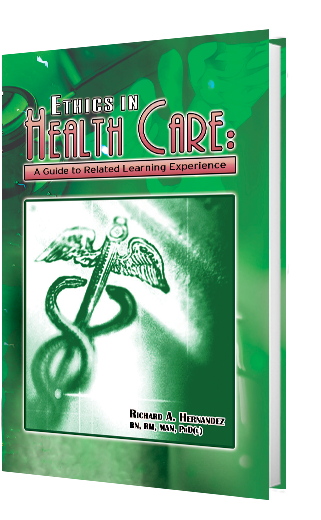
Ethics in Health Care

Author: Richard A. Hernandez

To act without rapacity, to use knowledge with wisdom, to respect interdependence, to operate without hubris and greed are not simply imperatives, they are an accurate scientific description of the means of survival

— Barbara Ward

You've got to be brave and you've got to be boa Brave enough to take your chance on your own discrimination — what's right and what's wrong, what's good and what's bad.

— Robert frost

Nursing is an important field in healthcare as it is the process for caring for, or nurturing client in all health care setting. It also refers to the care carried out by any individual who has had formal edification and preparation in the art and science of nursing. To further provide satisfactory service to their patients, nurses also have to observe moral and ethical principles and practices, as ethics and morals may serve to provide dilemmas and conflicts in rendering sufficient service to patients. In addition, ethical principles and morals must be properly given importance and significance in the nursing practice to ensure that the well-being and health of the patients would be given priority, thus, upholding and promoting the moral aspect of the practice. Ethical nursing practice involves the performance of nurses' roles and responsibilities which is facilitated with integration of social justice towards the promotion of life. Nurses should endeavor as much as possible individually and as a group to advocate for and eliminate social inequities, injustice and discrimination.

Today, nursing students are expected to think critically, and to utilize moral and ethical principles in carrying out their responsibilities during their related learning experiences. This book was made possible in anticipation of meeting learning needs, albeit the approach is synthesis of conceptual and theoretical highlights. Moreover, the purpose of this hook is to assist students integrate concepts of holistic nursing with the application of appropriate ethical and moral principles to all types of patients anytime in any health care setting.

Organization of the Text

Chapter 1: Ethics and Nursing Care focuses on the discussion of morality of an act and the significance of ethics in the health care industry.

Chapter 2: Approaches in Ethics highlights the factors to be considered in making decisions which are moral.

Chapter 3: The Roles of Nurse Ethicist enumerates the responsibilities of nurses to their patients, physicians and among others who are connected in the promotion of the client's welfare.

Chapter 4: Bioethical Principles discusses certain principles of ethics to be considered in making decision in times of conflicting issues, especially those that question the morality of an act.

Chapter 5: Issues on Family Planning discusses the different methods of natural and artificial family planning. It also enumerates propositions for and against institution of family planning.

Chapter 6: Issues on Abortion provides a discussion of different types of abortion and how the community at large reacts on the morality of this act.

Chapter 7: Issues on Euthanasia describes the different forms of euthanasia and enumerates some of the religious objections.

Chapter 8: Issues on In Vitro Fertilization describes the in vitro fertilization and discusses the morality of this act.

Chapter 9: Issues on Stem-cell Research describes stem cell and enumerates propositions for and against researches on stem cells.

Chapter 10: Issues on Medical Tourism focuses on the description, process and history of medical tourism and enumerates some of its legal and moral implications.

Categories: Ethics, Our Product. Tags: College Books, Ethics, Richard A. Hernandez.
share on
Facebook
pin this item
on Pinterest
share it on
Twitter
Send to a
friend

Related Products

  • Sociology and Anthropology with Family Planning 2011 (Saquilayan)

    Authors: Felisa U. Aguirre, Cecile D. Espiritu, Miramar I. Garcia, Jennifer M. Hobrero, Romeo R. Javines, Ma, Cristina D. Lopez, Maria Rosario E. Monce, Berlyn F. Pa-at, Evalyne A. Rodriquez, Benedict B. Santiago

    Sociology and Anthropology are exciting as well as challenging fields of scientific study. It is exciting because it is dynamic and challenging because it opens up a lot of avenues for a continuing knowledge and understanding about the world, people and events. It is about people who are engaged in daily and non-stop activity.

    As part of this life activity, this compendium is designed to sere as an introductory material on Sociology and Anthropology. Both scientific fields. although comparatively young in the academic world have been regarded not only as beneficial but moreso, very essential in the preparatory stage of one's understanding about life and the surrounding environment.

    The immensity of the subject on both fields of study is given. May this compendium aid the students through their teachers as they engage themselves in this study.

  • Introduction to Sociology (UM)

    Authors: Saidamin P. Bagolong, Maribeth Q. Galindo, Jackson A. Sison, Deanna Febra C. Rodinas

    The purpose of this textbook is to serve as reference for an introductory course in Sociology. The inclusion of family planning and other social issues provides background knowledge for an understanding of these, and other contemporary conditions.

    The book is likewise designed to facilitate the integral development of students for them to effect changes in the self as well as the environment thereby realizing the fullness of human life.

    Even though this is an introductory textbook, we have deliberately retained many of the salient features of sociology as a young discipline. This is the reason why we incorporated many social issues to stimulate students’ curiosity about learning society, culture, family planning, gender, environment and eve indigenous people.

    This textbook could not have been written without help from many people whose ideas we have borrowed, modified and incorporated. To them we are deeply indebted.

  • Flat Socio-Cultural

    Authors: Saidamin P. Bagolong, Allan Hil B. Pajimola, Bryan Lee D. Celeste

    The purpose of this textbook is to serve as a reference for an introductory course in Anthropology. This war, focus on concepts and theories of anthropology combined with both social and cultural understanding of humankind. Moreover; this will define basic terms of the course and how it can change your view of the world around you.

    The textbook is likewise designed to facilitate the integral development of students for them to effect changes in the self as well as in the environment, thereby realizing the fullness of human life.

    Even though this is an introductory textbook, we deliberately retain most of the salient features of anthropology as fairly new academic discipline.

    This textbook could not have been written without help from many people whose ideas we have borrowed, modified and incorporated. We owe these people a special debt.

Copyright © Mutya Publishing House, Inc. All Rights Reserved, 2020